



Bedankt voor het vertrouwen het afgelopen jaar! Om jou te bedanken bieden we GRATIS verzending (in België) aan op alles gedurende de hele maand januari.
- Afhalen na 1 uur in een winkel met voorraad
- In januari gratis thuislevering in België
- Ruim aanbod met 7 miljoen producten
Bedankt voor het vertrouwen het afgelopen jaar! Om jou te bedanken bieden we GRATIS verzending (in België) aan op alles gedurende de hele maand januari.
- Afhalen na 1 uur in een winkel met voorraad
- In januari gratis thuislevering in België
- Ruim aanbod met 7 miljoen producten





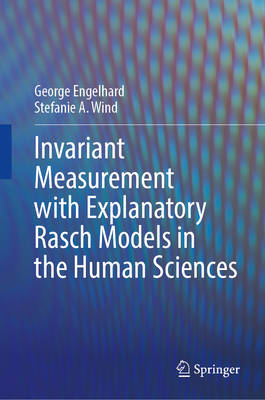
Invariant Measurement with Explanatory Rasch Models in the Human Sciences
George Engelhard, Stefanie A Wind
Hardcover | Engels
€ 183,45
+ 366 punten
Omschrijving
This textbook introduces invariant measurement in the human sciences based on the principles of Rasch measurement theory and presents explanatory Rasch models that integrate item and person covariates that can deepen the understanding of item response processes. The basic family of Rasch models reflects descriptive measurement models. This book describes explanatory item response models that can be used to explore and predict item response probabilities using item and person variables (covariates) that can be explicitly included in measurement models for the purpose of constructing scales to represent latent variables. The analyses described in this book offer methodological tools that can be used to delve more deeply into person responses to a set of items designed to represent a latent variable or construct. Item and person covariates provide insight into aspects of measurement procedures that may influence or explain measurement properties, such as item difficulty or level of person achievement. Rasch measurement theory provides the opportunity to include both person and item covariates that allows for more nuanced substantive analyses of latent variables that go beyond description. Across chapters, the book progresses from foundational principles and generalized linear mixed models (GLMMs) for estimating Rasch models, to applications in measurement quality evaluation, explanatory modeling, rater-mediated assessments, instrument development, and rating scale analysis. Invariant Measurement with Explanatory Rasch Models in the Human Sciences will be a valuable resource for advanced undergraduate and graduate students in the human sciences attending advanced undergraduate courses on test theory and measurement, as well as graduate-level courses and seminars on rating scales and invariant measurement. This book can also be used as a supplementary textbook in a variety of courses on research methodology in the social, behavioral and health sciences including psychology, public health, anthropology, sociology education and economics.
Specificaties
Betrokkenen
- Auteur(s):
- Uitgeverij:
Inhoud
- Aantal bladzijden:
- 249
- Taal:
- Engels
Eigenschappen
- Productcode (EAN):
- 9783032088154
- Verschijningsdatum:
- 7/01/2026
- Uitvoering:
- Hardcover
- Formaat:
- Genaaid
- Afmetingen:
- 155 mm x 235 mm


Alleen bij Standaard Boekhandel
+ 366 punten op je klantenkaart van Standaard Boekhandel
SOLDEN


Beoordelingen
We publiceren alleen reviews die voldoen aan de voorwaarden voor reviews. Bekijk onze voorwaarden voor reviews.