


- Afhalen na 1 uur in een winkel met voorraad
- Gratis thuislevering in België vanaf € 30
- Ruim aanbod met 7 miljoen producten
- Afhalen na 1 uur in een winkel met voorraad
- Gratis thuislevering in België vanaf € 30
- Ruim aanbod met 7 miljoen producten





Introduction to Supersymmetric Field Theory
Sergio M Kuzenko
€ 251,95
+ 503 punten
Omschrijving
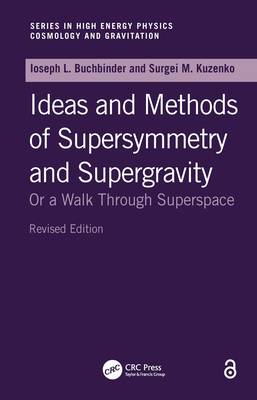
Ideas and Methods of Supersymmetry and Supergravity: Or a Walk Through Superspace provides a comprehensive, detailed, and self-contained account of four dimensional simple supersymmetry and supergravity. Throughout the book, the authors cultivate their material in detail with calculations and full discussions of the fundamental ideas and motivations. They develop the subject in its superfield formulations but where appropriate for illustration, analogy, and comparison with conventional field theory, they use the component formulation. The book discusses many subjects that, until now, can only be found in the research literature. In addition, it presents a plethora of new results. Combining classical and quantum field theory with group theory, differential geometry, and algebra, the book begins with a solid mathematical background that is used in the rest of the book. The next chapter covers algebraic aspects of supersymmetry and the concepts of superspace and superfield. In the following chapters, the book presents classical and quantum superfield theory and the superfield formulation of supergravity. A synthesis of results and methods developed in the book, the final chapter concludes with the theory of effective action in curved superspaces. After studying this book, readers should be well prepared to pursue independent research in any area of supersymmetry and supergravity. It will be an indispensable source of reference for advanced graduate students, postdoctoral faculty, and researchers involved in quantum field theory, high energy physics, gravity theory, mathematical physics, and applied mathematics.
Specificaties
Betrokkenen
- Auteur(s):
- Uitgeverij:
Inhoud
- Aantal bladzijden:
- 676
- Taal:
- Engels
- Reeks:
Eigenschappen
- Productcode (EAN):
- 9780750305068
- Verschijningsdatum:
- 1/01/1998
- Uitvoering:
- Hardcover
- Formaat:
- Genaaid
- Afmetingen:
- 155 mm x 233 mm
- Gewicht:
- 1088 g


Alleen bij Standaard Boekhandel
+ 503 punten op je klantenkaart van Standaard Boekhandel
Cadeau

AANGERADEN


Beoordelingen
We publiceren alleen reviews die voldoen aan de voorwaarden voor reviews. Bekijk onze voorwaarden voor reviews.