


- Afhalen na 1 uur in een winkel met voorraad
- Gratis thuislevering in België vanaf € 30
- Ruim aanbod met 7 miljoen producten
- Afhalen na 1 uur in een winkel met voorraad
- Gratis thuislevering in België vanaf € 30
- Ruim aanbod met 7 miljoen producten





€ 83,95
+ 167 punten
Omschrijving
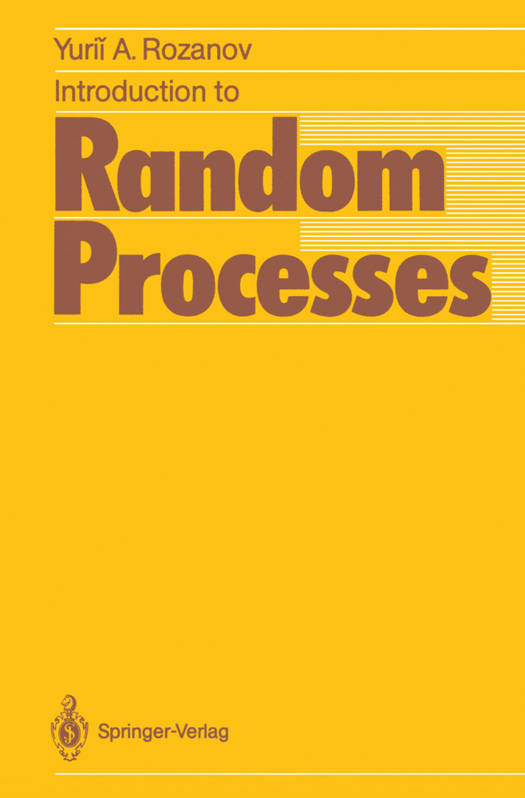
Today, the theory of random processes represents a large field of mathematics with many different branches, and the task of choosing topics for a brief introduction to this theory is far from being simple. This introduction to the theory of random processes uses mathematical models that are simple, but have some importance for applications. We consider different processes, whose development in time depends on some random factors. The fundamental problem can be briefly circumscribed in the following way: given some relatively simple characteristics of a process, compute the probability of another event which may be very complicated; or estimate a random variable which is related to the behaviour of the process. The models that we consider are chosen in such a way that it is possible to discuss the different methods of the theory of random processes by referring to these models. The book starts with a treatment of homogeneous Markov processes with a countable number of states. The main topic is the ergodic theorem, the method of Kolmogorov's differential equations (Secs. 1-4) and the Brownian motion process, the connecting link being the transition from Kolmogorov's differential-difference equations for random walk to a limit diffusion equation (Sec. 5).
Specificaties
Betrokkenen
- Auteur(s):
- Vertaler(s):
- Uitgeverij:
Inhoud
- Aantal bladzijden:
- 117
- Taal:
- Engels
- Reeks:
Eigenschappen
- Productcode (EAN):
- 9783642727191
- Verschijningsdatum:
- 6/12/2011
- Uitvoering:
- Paperback
- Formaat:
- Trade paperback (VS)
- Afmetingen:
- 156 mm x 234 mm
- Gewicht:
- 195 g


Alleen bij Standaard Boekhandel
+ 167 punten op je klantenkaart van Standaard Boekhandel
Wedstrijd


Beoordelingen
We publiceren alleen reviews die voldoen aan de voorwaarden voor reviews. Bekijk onze voorwaarden voor reviews.