


- Afhalen na 1 uur in een winkel met voorraad
- Gratis thuislevering in België vanaf € 30
- Ruim aanbod met 7 miljoen producten
- Afhalen na 1 uur in een winkel met voorraad
- Gratis thuislevering in België vanaf € 30
- Ruim aanbod met 7 miljoen producten





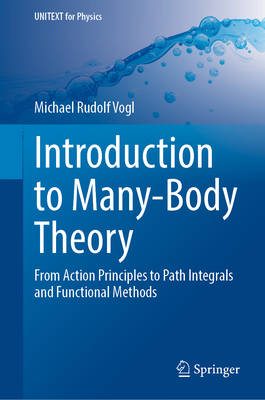
Introduction to Many-Body Theory
From Action Principles to Path Integrals and Functional Methods
Michael Rudolf Vogl
€ 75,95
+ 151 punten
Omschrijving
This textbook provides a self-contained introduction to many-body theory that bridges the gap between the standard graduate curriculum and more research-oriented courses in many-body theory. The author systematically constructs the basic formalism of many-body theory, starting from Newton's second law, and subsequently develops action principles and symmetry-based techniques. Upon switching to quantum theory, second quantization and the Feynman path integral are introduced. After a treatment of statistical mechanics from an information-entropy perspective, which allows for a simple understanding of temperature dependent variational principles, the book switches to a coherent state path-integral formulation. This approach makes diagrammatic perturbation theory, linear response techniques, and renormalization group methods, which are treated in later parts of the book, accessible to a broad audience.
The content of the book is based on a set of lectures on the Quantum Theory of Solids that the author has taught at King Fahd University of Petroleum and Minerals (KFUPM) every year since 2022. With detailed, explicit computations and exercises at various difficulty levels, the book serves as a valuable resource for talented undergraduate students, graduate students, beginning researchers and instructors. While familiarity with variational calculus and functional integration is advantageous, the book systematically constructs the necessary tools as needed, making it self-contained, and mastery of the skills is not considered a prerequisite.
Each chapter of the book also includes a summary and a set of problems, separated into introductory and advanced levels. This setup allows readers to master concepts efficiently and helps develop their skills up to an advanced level.
Specificaties
Betrokkenen
- Auteur(s):
- Uitgeverij:
Inhoud
- Aantal bladzijden:
- 269
- Taal:
- Engels
- Reeks:
Eigenschappen
- Productcode (EAN):
- 9783032197658
- Verschijningsdatum:
- 23/06/2026
- Uitvoering:
- Hardcover
- Formaat:
- Genaaid
- Afmetingen:
- 155 mm x 235 mm


Alleen bij Standaard Boekhandel
+ 151 punten op je klantenkaart van Standaard Boekhandel
Cadeau

AANGERADEN


Beoordelingen
We publiceren alleen reviews die voldoen aan de voorwaarden voor reviews. Bekijk onze voorwaarden voor reviews.