



Bedankt voor het vertrouwen het afgelopen jaar! Om jou te bedanken bieden we GRATIS verzending (in België) aan op alles gedurende de hele maand januari.
- Afhalen na 1 uur in een winkel met voorraad
- In januari gratis thuislevering in België
- Ruim aanbod met 7 miljoen producten
Bedankt voor het vertrouwen het afgelopen jaar! Om jou te bedanken bieden we GRATIS verzending (in België) aan op alles gedurende de hele maand januari.
- Afhalen na 1 uur in een winkel met voorraad
- In januari gratis thuislevering in België
- Ruim aanbod met 7 miljoen producten





€ 88,45
+ 176 punten
Uitvoering
Omschrijving
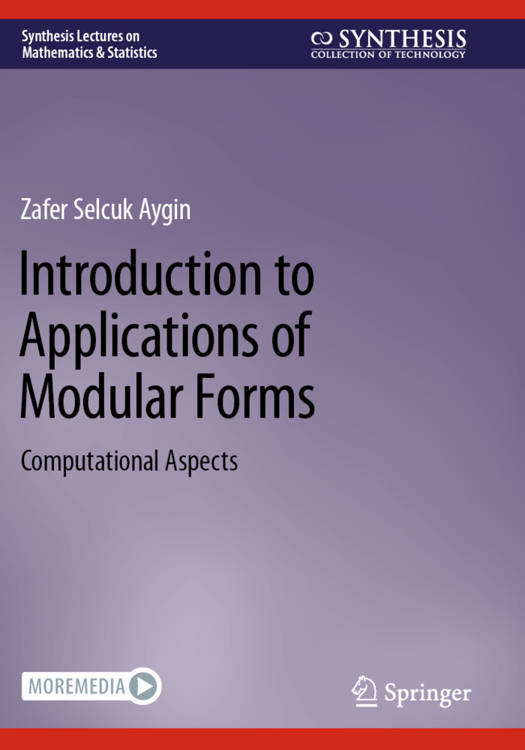
This book is a self-contained treatment for those who study or work on the computational aspects of classical modular forms. The author describes the theory of modular forms and its applications in number theoretic problems such as representations by quadratic forms and the determination of asymptotic formulas for Fourier coefficients of different types of special functions. A detailed account of recent applications of modular forms in number theory with a focus on using computer algorithms is provided. Computer algorithms are included for each presented application to help readers put the theory in context and make new conjectures.
Specificaties
Betrokkenen
- Auteur(s):
- Uitgeverij:
Inhoud
- Aantal bladzijden:
- 169
- Taal:
- Engels
- Reeks:
Eigenschappen
- Productcode (EAN):
- 9783031326318
- Verschijningsdatum:
- 15/07/2024
- Uitvoering:
- Paperback
- Formaat:
- Trade paperback (VS)
- Afmetingen:
- 168 mm x 240 mm
- Gewicht:
- 313 g


Alleen bij Standaard Boekhandel
+ 176 punten op je klantenkaart van Standaard Boekhandel
SOLDEN


Beoordelingen
We publiceren alleen reviews die voldoen aan de voorwaarden voor reviews. Bekijk onze voorwaarden voor reviews.