


- Afhalen na 1 uur in een winkel met voorraad
- Gratis thuislevering in België vanaf € 30
- Ruim aanbod met 7 miljoen producten
- Afhalen na 1 uur in een winkel met voorraad
- Gratis thuislevering in België vanaf € 30
- Ruim aanbod met 7 miljoen producten





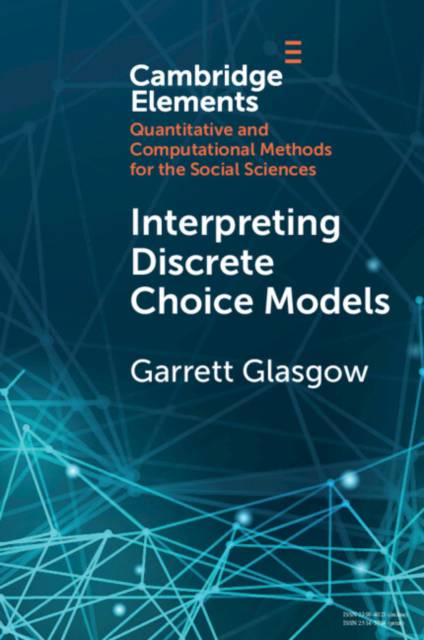
Interpreting Discrete Choice Models
Garrett Glasgow
€ 36,45
+ 72 punten
Omschrijving
In discrete choice models the relationships between the independent variables and the choice probabilities are nonlinear, depending on both the value of the particular independent variable being interpreted and the values of the other independent variables. Thus, interpreting the magnitude of the effects (the "substantive effects") of the independent variables on choice behavior requires the use of additional interpretative techniques. Three common techniques for interpretation are described here: first differences, marginal effects and elasticities, and odds ratios. Concepts related to these techniques are also discussed, as well as methods to account for estimation uncertainty. Interpretation of binary logits, ordered logits, multinomial and conditional logits, and mixed discrete choice models such as mixed multinomial logits and random effects logits for panel data are covered in detail. The techniques discussed here are general, and can be applied to other models with discrete dependent variables which are not specifically described here.
Specificaties
Betrokkenen
- Auteur(s):
- Uitgeverij:
Inhoud
- Aantal bladzijden:
- 84
- Taal:
- Engels
- Reeks:
Eigenschappen
- Productcode (EAN):
- 9781108819404
- Verschijningsdatum:
- 12/05/2022
- Uitvoering:
- Paperback
- Formaat:
- Trade paperback (VS)
- Afmetingen:
- 152 mm x 229 mm
- Gewicht:
- 122 g


Alleen bij Standaard Boekhandel
+ 72 punten op je klantenkaart van Standaard Boekhandel
Cadeau

AANGERADEN


Beoordelingen
We publiceren alleen reviews die voldoen aan de voorwaarden voor reviews. Bekijk onze voorwaarden voor reviews.