


- Afhalen na 1 uur in een winkel met voorraad
- Gratis thuislevering in België vanaf € 30
- Ruim aanbod met 7 miljoen producten
- Afhalen na 1 uur in een winkel met voorraad
- Gratis thuislevering in België vanaf € 30
- Ruim aanbod met 7 miljoen producten





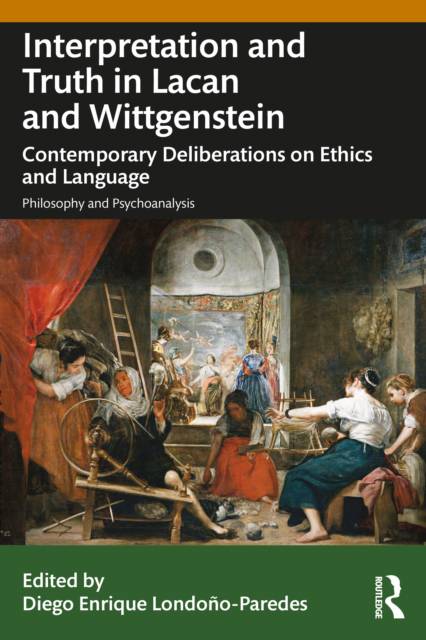
Interpretation and Truth in Lacan and Wittgenstein
Contemporary Deliberations on Ethics and Language
€ 47,45
+ 94 punten
Omschrijving
This book offers a compelling exploration of how language shapes truth, subjectivity, and ethical life. Bringing together psychoanalysis and philosophy, it stages a rigorous dialogue between Lacan and Wittgenstein to address a question of broad human interest: how do we make sense of what we say, and what does it mean for that sense to be true?
Expanding on this, the volume examines the consequences of the "linguistic turn" for both philosophy and psychoanalysis, contrasting early and later Wittgenstein with Freudian and Lacanian approaches to interpretation. It analyzes key tensions between explanation and description, reference and use, proposition and enunciation, while engaging debates on the limits of meaning, the role of desire and fantasy, and the status of the Real. The book also extends these discussions into contemporary contexts, including digital communication, where symbolic practices such as memes and hashtags reshape meaning and subjectivity.
What distinguishes this work is its insistence that truth is not a fixed correspondence but an emergent, contingent effect within linguistic practices marked by incompleteness. Its originality lies in articulating a non-reductive dialogue between analytic philosophy and psychoanalysis, making it especially valuable for scholars of philosophy, psychoanalysis, and critical theory.
Specificaties
Betrokkenen
- Uitgeverij:
Inhoud
- Aantal bladzijden:
- 198
- Taal:
- Engels
- Reeks:
Eigenschappen
- Productcode (EAN):
- 9781041161622
- Verschijningsdatum:
- 20/11/2026
- Uitvoering:
- Paperback
- Formaat:
- Trade paperback (VS)
- Afmetingen:
- 156 mm x 233 mm

Alleen bij Standaard Boekhandel
+ 94 punten op je klantenkaart van Standaard Boekhandel
Cadeau

AANGERADEN


Beoordelingen
We publiceren alleen reviews die voldoen aan de voorwaarden voor reviews. Bekijk onze voorwaarden voor reviews.