


- Afhalen na 1 uur in een winkel met voorraad
- Gratis thuislevering in België vanaf € 30
- Ruim aanbod met 7 miljoen producten
- Afhalen na 1 uur in een winkel met voorraad
- Gratis thuislevering in België vanaf € 30
- Ruim aanbod met 7 miljoen producten




Omschrijving
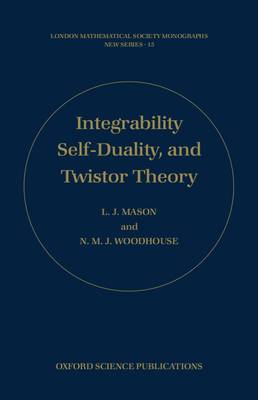
Many of the familiar integrable systems of equations are symmetry reductions of self-duality equations on a metric or on a Yang-Mills connection. For example, the Korteweg-de Vries and non-linear Schrodinger equations are reductions of the self-dual Yang-Mills equation. This book explores in detail the connections between self-duality and integrability, and also the application of twistor techniques to integrable systems. It supports two central theories: that the symmetries of self-duality equations provide a natural classification scheme for integrable systems; and that twistor theory provides a uniform geometric framework for the study of Backlund transformations, the inverse scattering method, and other such general constructions of integrability theory. The book will be useful to researchers and graduate students in mathematical physics.
Specificaties
Betrokkenen
- Auteur(s):
- Uitgeverij:
Inhoud
- Aantal bladzijden:
- 376
- Taal:
- Engels
- Reeks:
- Reeksnummer:
- nr. 15
Eigenschappen
- Productcode (EAN):
- 9780198534983
- Verschijningsdatum:
- 30/01/1997
- Uitvoering:
- Hardcover
- Formaat:
- Genaaid
- Afmetingen:
- 156 mm x 234 mm
- Gewicht:
- 703 g


Alleen bij Standaard Boekhandel
Cadeau

AANGERADEN


Beoordelingen
We publiceren alleen reviews die voldoen aan de voorwaarden voor reviews. Bekijk onze voorwaarden voor reviews.