


- Afhalen na 1 uur in een winkel met voorraad
- Gratis thuislevering in België vanaf € 30
- Ruim aanbod met 7 miljoen producten
- Afhalen na 1 uur in een winkel met voorraad
- Gratis thuislevering in België vanaf € 30
- Ruim aanbod met 7 miljoen producten





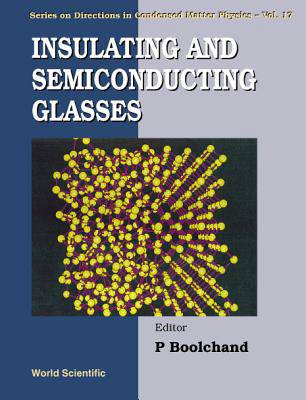
Insulating & Semiconducting Glasses
€ 303,45
+ 606 punten
Omschrijving
This book reviews principal topical issues on the basic science of glasses and amorphous thin-films. It also includes select applications of these materials in current and evolving technologies, including optical recording, imaging, solar cells, battery technology and field-emission displays.The glass systems of interest include oxides, chalcogenides and chalcohalides of the group III, IV and V elements, as well as amorphous thin-films of the group IV elements. Glass formation in covalent melts can be understood in terms of new ideas based on constraint counting algorithms which have led to the fragile-strong classification and to the concept of rigidity transition. Vibrational excitations and characterization of the atomic scale structure at various length scales are addressed by an array of experimental probes, including X-ray and neutron scattering, Brillouin scattering, Raman scattering and infrared reflectance, solid state nuclear magnetic resonance, nuclear quadrupole resonance and Mössbauer spectroscopy. Chapters are also devoted to the physics of electronic transport in amorphous materials, to the physics of tunneling states in crystalline and amorphous solids, and the physics of light-induced effects in glasses. In addition, a chapter is devoted to the rapidly evolving field of numerical simulations of disordered systems by computer modeling. Each of these topics is discussed by experts who have made significant contributions to the field.The book can serve as a text for a graduate course in glass science. For an established researcher, it provides, in a concise form, a large body of experimental data on the basic materials research aspect of these fascinating materials.
Specificaties
Betrokkenen
- Uitgeverij:
Inhoud
- Aantal bladzijden:
- 896
- Taal:
- Engels
- Reeks:
- Reeksnummer:
- nr. 17
Eigenschappen
- Productcode (EAN):
- 9789810236731
- Verschijningsdatum:
- 26/05/2000
- Uitvoering:
- Hardcover
- Formaat:
- Genaaid

Alleen bij Standaard Boekhandel
+ 606 punten op je klantenkaart van Standaard Boekhandel
Cadeau

AANGERADEN


Beoordelingen
We publiceren alleen reviews die voldoen aan de voorwaarden voor reviews. Bekijk onze voorwaarden voor reviews.