



Je cadeautjes zeker op tijd in huis hebben voor de feestdagen? Kom langs in onze winkels en vind het perfecte geschenk!
- Afhalen na 1 uur in een winkel met voorraad
- Gratis thuislevering in België vanaf € 30
- Ruim aanbod met 7 miljoen producten
Je cadeautjes zeker op tijd in huis hebben voor de feestdagen? Kom langs in onze winkels en vind het perfecte geschenk!
- Afhalen na 1 uur in een winkel met voorraad
- Gratis thuislevering in België vanaf € 30
- Ruim aanbod met 7 miljoen producten





€ 59,45
+ 118 punten
Omschrijving
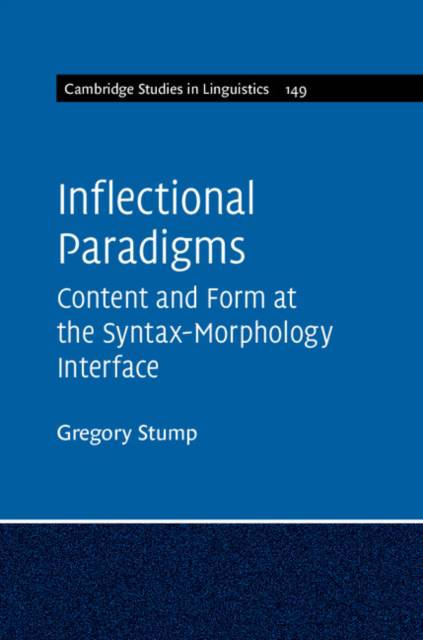
Sometimes dismissed as linguistically epiphenomenal, inflectional paradigms are, in reality, the interface of a language's morphology with its syntax and semantics. Drawing on abundant evidence from a wide range of languages (French, Hua, Hungarian, Kashmiri, Latin, Nepali, Noon, Old Norse, Sanskrit, Turkish, Twi and others), Stump examines a variety of mismatches between words' content and form, including morphomic patterns, defectiveness, overabundance, syncretism, suppletion, deponency and polyfunctionality. He demonstrates that such mismatches motivate a new grammatical architecture in which two kinds of paradigms are distinguished: content paradigms, which determine word forms' syntactic distribution and semantic interpretation, and form paradigms, which determine their inflectional realization. In this framework, the often nontrivial linkage between a lexeme's content paradigm and its stems' form paradigm is the nexus at which incongruities of content and form are resolved. Stump presents clear and precise analyses of a range of morphological phenomena in support of this theoretical innovation.
Specificaties
Betrokkenen
- Auteur(s):
- Uitgeverij:
Inhoud
- Aantal bladzijden:
- 239
- Taal:
- Engels
- Reeks:
- Reeksnummer:
- nr. 149
Eigenschappen
- Productcode (EAN):
- 9781107460850
- Verschijningsdatum:
- 30/12/2015
- Uitvoering:
- Paperback
- Formaat:
- Trade paperback (VS)
- Afmetingen:
- 152 mm x 231 mm
- Gewicht:
- 430 g



Alleen bij Standaard Boekhandel
+ 118 punten op je klantenkaart van Standaard Boekhandel
CADEAU


Beoordelingen
We publiceren alleen reviews die voldoen aan de voorwaarden voor reviews. Bekijk onze voorwaarden voor reviews.