


- Afhalen na 1 uur in een winkel met voorraad
- Gratis thuislevering in België vanaf € 30
- Ruim aanbod met 7 miljoen producten
- Afhalen na 1 uur in een winkel met voorraad
- Gratis thuislevering in België vanaf € 30
- Ruim aanbod met 7 miljoen producten





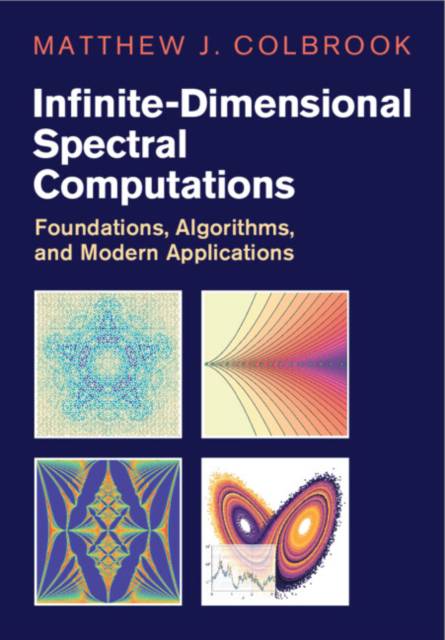
Infinite-Dimensional Spectral Computations
Foundations, Algorithms, and Modern Applications
Matthew J Colbrook
€ 168,95
+ 337 punten
Omschrijving
Mathematicians, physicists, engineers, and data scientists will welcome this comprehensive, practical guide to computing spectral properties of operators in infinite-dimensional settings with rigorous guarantees. It explains why standard discretisation can fail and shows how to overcome these pitfalls. It develops resolvent-based algorithms with provable convergence and certified error bounds, organised by a precise computability classification that clarifies what is achievable, what is impossible, and what extra information makes problems tractable. Topics include spectra and pseudospectra, spectral measures and functional calculus, spectral types, fractal and Cantor-type spectra, essential versus discrete spectra and multiplicities, spectral radii, abscissas and gaps, nonlinear operator pencils, and verified computation. A distinctive feature is the integration of modern applications, including a fully rigorous treatment of data-driven Koopman spectral analysis. Hundreds of worked examples, exercises with solutions, notes, and usable code make the book both a reference and a practical toolkit for researchers and students.
Specificaties
Betrokkenen
- Auteur(s):
- Uitgeverij:
Inhoud
- Aantal bladzijden:
- 705
- Taal:
- Engels
- Reeks:
Eigenschappen
- Productcode (EAN):
- 9781009382526
- Verschijningsdatum:
- 31/08/2026
- Uitvoering:
- Hardcover
- Formaat:
- Genaaid
- Afmetingen:
- 254 mm


Alleen bij Standaard Boekhandel
+ 337 punten op je klantenkaart van Standaard Boekhandel
Cadeau

AANGERADEN


Beoordelingen
We publiceren alleen reviews die voldoen aan de voorwaarden voor reviews. Bekijk onze voorwaarden voor reviews.