


- Afhalen na 1 uur in een winkel met voorraad
- Gratis thuislevering in België vanaf € 30
- Ruim aanbod met 7 miljoen producten
- Afhalen na 1 uur in een winkel met voorraad
- Gratis thuislevering in België vanaf € 30
- Ruim aanbod met 7 miljoen producten





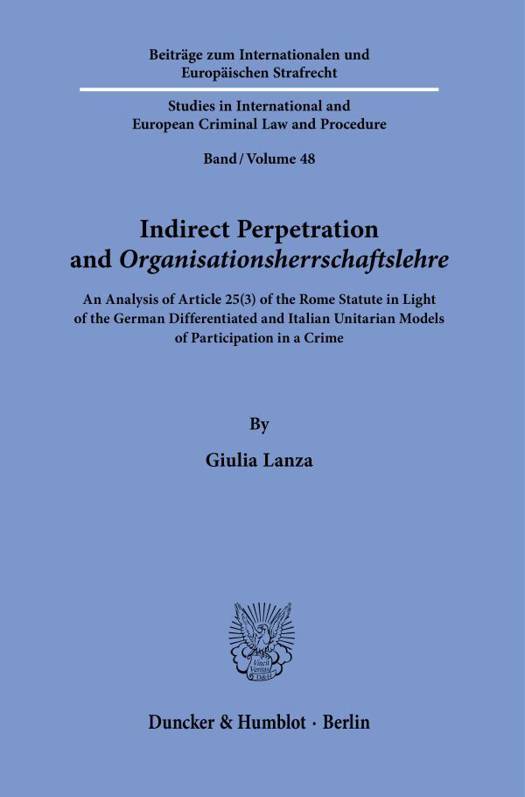
Indirect Perpetration and Organisationsherrschaftslehre
An Analysis of Article 25(3) of the Rome Statute in Light of the German Differentiated and Italian Unitarian Models of Participation in a Crime
Giulia Lanza
€ 222,45
+ 444 punten
Omschrijving
The book analyses indirect perpetration within the meaning and interpretation of article 25(3)(a), third alternative, of the Rome Statute from a comparative perspective. Through a critical analysis, Giulia Lanza examines the control over the organization theory, adopted by the majority to interpret the provision. The objective of the author is to verify whether the dominant approach - resulting from the transposition of Roxin's Organisationsherrschaftslehre at the ICC - constitutes a feasible solution in the interpretation and application of article 25 (3)(a), third alternative, of the Rome Statute, or whether it is preferable to rely on different approaches inspired by other legal systems, such as the Italian system. The author concludes that the reliance on the Organisationsherrschaftslehre constitutes an important step in the path towards the development of autonomous ICL doctrine regarding indirect perpetration.
Specificaties
Betrokkenen
- Auteur(s):
- Uitgeverij:
Inhoud
- Aantal bladzijden:
- 286
- Taal:
- Engels
- Reeks:
- Reeksnummer:
- nr. 48
Eigenschappen
- Productcode (EAN):
- 9783428183593
- Verschijningsdatum:
- 25/08/2021
- Uitvoering:
- Paperback
- Formaat:
- Trade paperback (VS)
- Afmetingen:
- 155 mm x 231 mm
- Gewicht:
- 4386 g


Alleen bij Standaard Boekhandel
+ 444 punten op je klantenkaart van Standaard Boekhandel
AANGERADEN


Beoordelingen
We publiceren alleen reviews die voldoen aan de voorwaarden voor reviews. Bekijk onze voorwaarden voor reviews.