


- Afhalen na 1 uur in een winkel met voorraad
- Gratis thuislevering in België vanaf € 30
- Ruim aanbod met 7 miljoen producten
- Afhalen na 1 uur in een winkel met voorraad
- Gratis thuislevering in België vanaf € 30
- Ruim aanbod met 7 miljoen producten





Omschrijving
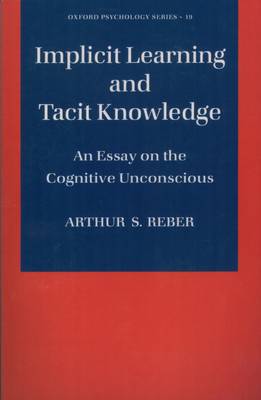
In this new volume in the Oxford Psychology Series, the author presents a highly readable account of the cognitive unconscious, focusing in particular on the problem of implicit learning. Implicit learning is defined as the acquisition of knowledge that takes place independently of the conscious attempts to learn and largely in the absence of explicit knowledge about what was acquired. One of the core assumptions of this argument is that implicit learning is a fundamental, "root" process, one that lies at the very heart of the adaptive behavioral repertoire of every complex organism. The author's goals are to outline the essential features of implicit learning that have emerged from the many studies that have been carried out in a variety of experimental laboratories over the past several decades; to present the various alternative perspectives on this issue that have been proposed by other researchers and to try to accommodate these views with his own; to structure the literature so that it can be seen in the context of standard heuristics of evolutionary biology; to present the material within a functionalist approach and to try to show why the experimental data should be seen as entailing particular epistemological perspectives; and to present implicit processing as encompassing a general and ubiquitous set of operations that have wide currency and several possible applications. Chapter 1 begins with the core problem under consideration in this book, a characterization of "implicit learning" as it has come to be used in the literature. Reber puts this seemingly specialized topic into a general framework and suggests a theoretical model based on standard heuristics of evolutionary biology. In his account, Reber weaves a capsule history of interest in and work on the cognitive unconscious. Chapter 2 turns to a detailed overview of the experimental work on the acquisition of implicit knowledge, which currently is of great interest. Chapter 3 develops the evolutionary model within which one can see learning and cognition as richly intertwining issues and not as two distinct fields with one dominating the other. Finally, Chapter 4 explores a variety of entailments and speculations concerning implicit cognitive processes and their general role in the larger scope of human performance.
Specificaties
Betrokkenen
- Auteur(s):
- Uitgeverij:
Inhoud
- Aantal bladzijden:
- 200
- Taal:
- Engels
- Reeks:
- Reeksnummer:
- nr. 19
Eigenschappen
- Productcode (EAN):
- 9780195106589
- Verschijningsdatum:
- 5/09/1996
- Uitvoering:
- Paperback
- Formaat:
- Trade paperback (VS)
- Afmetingen:
- 157 mm x 234 mm
- Gewicht:
- 290 g


Alleen bij Standaard Boekhandel
Cadeau

AANGERADEN


Beoordelingen
We publiceren alleen reviews die voldoen aan de voorwaarden voor reviews. Bekijk onze voorwaarden voor reviews.