


- Afhalen na 1 uur in een winkel met voorraad
- Gratis thuislevering in België vanaf € 30
- Ruim aanbod met 7 miljoen producten
- Afhalen na 1 uur in een winkel met voorraad
- Gratis thuislevering in België vanaf € 30
- Ruim aanbod met 7 miljoen producten





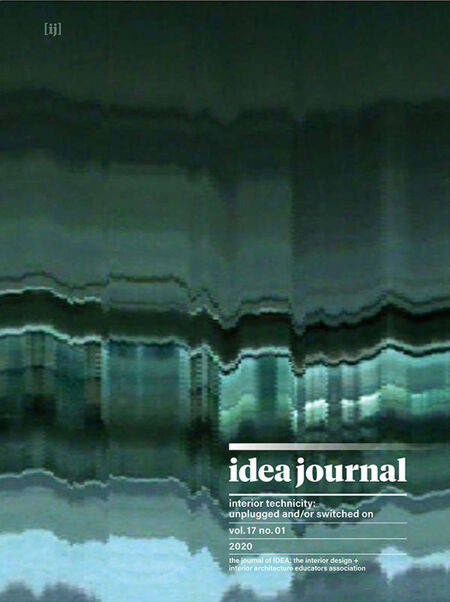
idea journal: interior technicity: unplugged and/or switched on E-BOOK
vol. 17 no. 01 2020
€ 13,99
+ 13 punten
Omschrijving
Interior Technicity: Unplugged and/ or Switched On invites reflection on how interiors have always been augmenting entities and how they continue to be so—in other words, extending, facilitating and consolidating bodies within socio-cultural environments. Rather than seeing an interior as an 'inside' in opposition to a world beyond, it asks what modes of 'folding inward' have equipped and enabled the spatial environment? Technicity—the world of tools and technical objects that extend and mediate memory, as Bernard Steigler (1998) describes it—has never been what inside-ness, in its sheltering of life, keeps at bay; mediation is from the start technical, indexed to inscribing practices rich in temporal and embodied implications. By this reading, interiors have always been augmented and augmenting (in the sense of the Latin"augmentare": to increase, enlarge, or enrich).
This IDEA Journal issue considers this mode of 'folding inward' as a condition of an interior'sspecificity. Whether it be a small structure such as a tramping hut or a tiny house, a large complex interior environment such as an airport or shopping mall, handmade with local materials such as Samoan fale, or the result of manufacturing processes assembling artificial and prefabricated elements as in the case of a spacecraft, boat or train, interiors are augmented, mediated, generated or embellished by technologies. The effect of these technologies is not neutral; one's experience of an interior is significantly influenced by the affective resonance of its technologies.
This IDEA Journal issue considers this mode of 'folding inward' as a condition of an interior'sspecificity. Whether it be a small structure such as a tramping hut or a tiny house, a large complex interior environment such as an airport or shopping mall, handmade with local materials such as Samoan fale, or the result of manufacturing processes assembling artificial and prefabricated elements as in the case of a spacecraft, boat or train, interiors are augmented, mediated, generated or embellished by technologies. The effect of these technologies is not neutral; one's experience of an interior is significantly influenced by the affective resonance of its technologies.
Specificaties
Betrokkenen
- Uitgeverij:
Inhoud
- Aantal bladzijden:
- 258
- Taal:
- Engels
- Reeks:
Eigenschappen
- Productcode (EAN):
- 9783887788209
- Verschijningsdatum:
- 6/10/2020
- Uitvoering:
- E-book
- Beveiligd met:
- Digital watermarking
- Formaat:

Alleen bij Standaard Boekhandel
+ 13 punten op je klantenkaart van Standaard Boekhandel
Cadeau

AANGERADEN


Beoordelingen
We publiceren alleen reviews die voldoen aan de voorwaarden voor reviews. Bekijk onze voorwaarden voor reviews.