


- Afhalen na 1 uur in een winkel met voorraad
- Gratis thuislevering in België vanaf € 30
- Ruim aanbod met 7 miljoen producten
- Afhalen na 1 uur in een winkel met voorraad
- Gratis thuislevering in België vanaf € 30
- Ruim aanbod met 7 miljoen producten





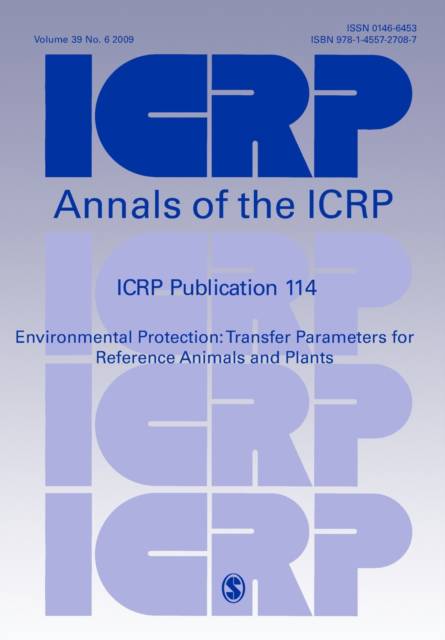
ICRP Publication 114
Environmental Protection: Transfer Parameters for Reference Animals and Plants
Icrp
€ 203,45
+ 406 punten
Omschrijving
In Publication 103, the Commission included a section on the protection of the environment, and indicated that it would be further developing its approach to this difficult subject by way of a set of Reference Animals and Plants (RAPs) as the basis for relating exposure to dose, and dose to radiation effects, for different types of animals and plants.
Subsequently, a set of 12 RAPs has been described in some detail, particularly with regard to estimation of the doses received by them, at a whole-body level, in relation to internal and external radionuclide concentrations; and what is known about the effects of radiation on such types of animals and plants. A set of dose conversion factors for all of the RAPs has been derived, and the resultant dose rates can be compared with evaluations of the effects of dose rates using derived consideration reference levels (DCRLs). Each DCRL constitutes a band of dose rates for each RAP within which there is likely to be some chance of the occurrence of deleterious effects. Site-specific data on Representative Organisms (i.e. organisms of specific interest for an assessment) can then be compared with such values and used as a basis for decision making.
Subsequently, a set of 12 RAPs has been described in some detail, particularly with regard to estimation of the doses received by them, at a whole-body level, in relation to internal and external radionuclide concentrations; and what is known about the effects of radiation on such types of animals and plants. A set of dose conversion factors for all of the RAPs has been derived, and the resultant dose rates can be compared with evaluations of the effects of dose rates using derived consideration reference levels (DCRLs). Each DCRL constitutes a band of dose rates for each RAP within which there is likely to be some chance of the occurrence of deleterious effects. Site-specific data on Representative Organisms (i.e. organisms of specific interest for an assessment) can then be compared with such values and used as a basis for decision making.
Specificaties
Betrokkenen
- Auteur(s):
- Uitgeverij:
Inhoud
- Aantal bladzijden:
- 112
- Taal:
- Engels
- Reeks:
Eigenschappen
- Productcode (EAN):
- 9781455727087
- Verschijningsdatum:
- 1/03/2012
- Uitvoering:
- Paperback
- Formaat:
- Trade paperback (VS)
- Afmetingen:
- 163 mm x 236 mm
- Gewicht:
- 158 g


Alleen bij Standaard Boekhandel
+ 406 punten op je klantenkaart van Standaard Boekhandel

Beoordelingen
We publiceren alleen reviews die voldoen aan de voorwaarden voor reviews. Bekijk onze voorwaarden voor reviews.