


- Afhalen na 1 uur in een winkel met voorraad
- Gratis thuislevering in België vanaf € 30
- Ruim aanbod met 7 miljoen producten
- Afhalen na 1 uur in een winkel met voorraad
- Gratis thuislevering in België vanaf € 30
- Ruim aanbod met 7 miljoen producten





Omschrijving
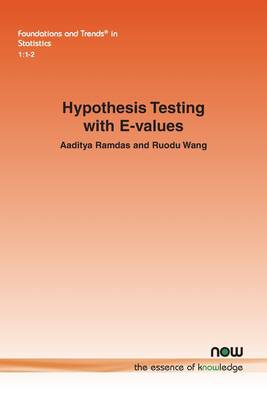
An e-value is a nonnegative test statistic whose expected value is at most one under the null hypothesis. This monograph is written to offer a humble, but unified, treatment of e-values in hypothesis testing. The need for such a work at this time can be explained by at least four reasons: (a) e-values have been named, utilized, and studied as a stand-alone concept only in the last few years, and a large body of its potential users do not know what they are; (b) e-values are fundamental objects at the core of hypothesis testing and estimation, and they are both under-studied and under-utilized; (c) several application domains in the natural and social sciences would benefit from knowing and adopting methodologies based on e-values in certain contexts to improve statistical efficiency and scientific reproducibility; (d) there has been an explosion of exciting research over the past few years, and hence the time is ripe to collate resources in a self-contained and concise manner. The monograph is organized into three parts: Fundamental Concepts, Core Ideas, and Advanced Topics. The first part includes four sections that introduce the basic concepts. The second part includes five sections of core ideas such as universal inference, log-optimality, e-processes, operations on e-values, and e-values in multiple testing. The third part contains seven sections of advanced topics. The monograph collates important results from a variety of modern papers on e-values and related concepts, and also contains many results not published elsewhere. It offers a coherent and comprehensive picture on a fast-growing research area, and is ready to use as the basis of a graduate course in statistics and related fields.
Specificaties
Betrokkenen
- Auteur(s):
- Uitgeverij:
Inhoud
- Aantal bladzijden:
- 426
- Taal:
- Engels
- Reeks:
Eigenschappen
- Productcode (EAN):
- 9781638285908
- Verschijningsdatum:
- 10/09/2025
- Uitvoering:
- Paperback
- Formaat:
- Trade paperback (VS)
- Afmetingen:
- 156 mm x 234 mm
- Gewicht:
- 594 g


Alleen bij Standaard Boekhandel
+ 268 punten op je klantenkaart van Standaard Boekhandel
Cadeau

AANGERADEN


Beoordelingen
We publiceren alleen reviews die voldoen aan de voorwaarden voor reviews. Bekijk onze voorwaarden voor reviews.