


- Afhalen na 1 uur in een winkel met voorraad
- Gratis thuislevering in België vanaf € 30
- Ruim aanbod met 7 miljoen producten
- Afhalen na 1 uur in een winkel met voorraad
- Gratis thuislevering in België vanaf € 30
- Ruim aanbod met 7 miljoen producten





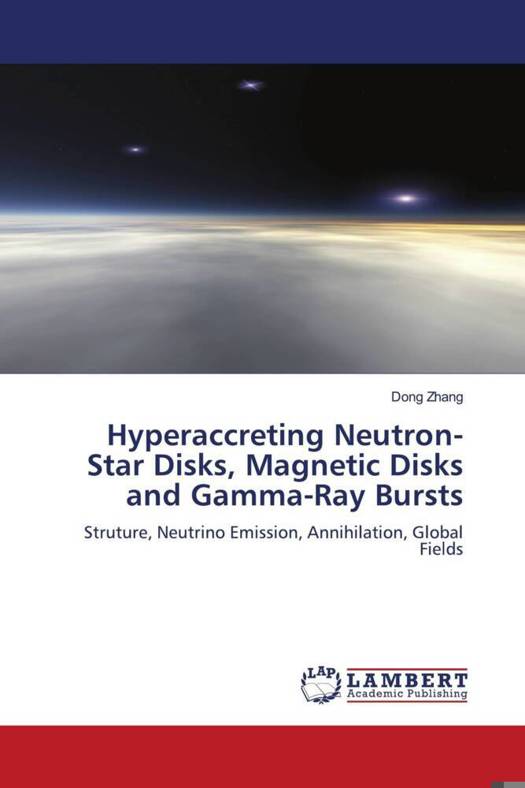
Hyperaccreting Neutron-Star Disks, Magnetic Disks and Gamma-Ray Bursts
Struture, Neutrino Emission, Annihilation, Global Fields
Dong Zhang
Paperback | Engels
€ 77,95
+ 155 punten
Omschrijving
Gamma-ray bursts (GRBs) have been an enigma since their discoveries. What are the nature of progenitors and the central engine for GRBs? It is usually proposed that hyperaccreting disks surrounding stellar-mass black holes are GRB central engines. My thesis focus on the hyperaccreting neutron-star disks cooled via neutrino emission as another potential central engine of GRBs. We study the structure and neutrino emission of such a neutron-star disk. As a reasonable approximation, we divide the disk into the inner and outer regions. The outer disk is similar to that of a black hole disk, while the inner disk has a self-similar structure. The neutron-star disk can cool more efficiently, produce much higher neutrino luminosity and neutrino annihilation luminosity than a black hole counterpart. The neutron star surface boundary layer could increase the annihilation luminosity as well. An ultra relativistic jet via neutrino annihilation can be produced along the stellar poles. Moreover, we study the effects of a global magnetic field on the disks around compact objects using a self-similar treatment. We also give a review on GRB progenitors, central engines and an outlook in this thesis.
Specificaties
Betrokkenen
- Auteur(s):
- Uitgeverij:
Inhoud
- Aantal bladzijden:
- 264
- Taal:
- Engels
Eigenschappen
- Productcode (EAN):
- 9783838332192
- Uitvoering:
- Paperback
- Afmetingen:
- 150 mm x 220 mm


Alleen bij Standaard Boekhandel
+ 155 punten op je klantenkaart van Standaard Boekhandel
AANGERADEN


Beoordelingen
We publiceren alleen reviews die voldoen aan de voorwaarden voor reviews. Bekijk onze voorwaarden voor reviews.