


- Afhalen na 1 uur in een winkel met voorraad
- Gratis thuislevering in België vanaf € 30
- Ruim aanbod met 7 miljoen producten
- Afhalen na 1 uur in een winkel met voorraad
- Gratis thuislevering in België vanaf € 30
- Ruim aanbod met 7 miljoen producten





€ 88,95
+ 177 punten
Omschrijving
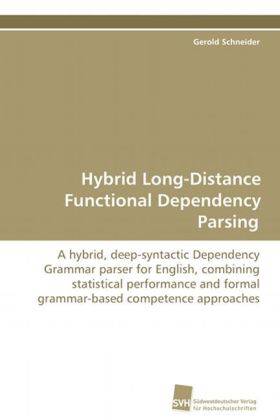
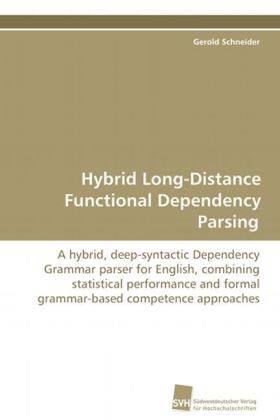
We propose a robust, hybrid, deep-syntactic dependency-based parser and present its implementation and evaluation. The parser is designed to keep search-spaces small without compromising much on the linguistic performance or adequacy. The resulting parser is deep-syntactic like a formal grammar-based parser while mostly context-free and fast enough for large-scale application. It combines successful current approaches into a hybrid, modular and open model. We suggest, implement, and evaluate a parsing architecture that is fast, robust and efficient enough to allow users to do broad-coverage parsing of unrestricted texts from varied domains. We present a probability model and a combination between a rule-based competence grammar and a statistical lexicalized performance disambiguation model. We treat long-distance dependencies with post-processing and mild context-sensitivity. We conclude that labelled Dependency Grammar is sufficiently expressive for linguistically adequate parsing. We argue that our parser covers the middle ground between statistical parsing and formal grammar-based parsing. The parser has competitive performance and has been applied widely.
Specificaties
Betrokkenen
- Auteur(s):
- Uitgeverij:
Inhoud
- Aantal bladzijden:
- 304
- Taal:
- Duits
Eigenschappen
- Productcode (EAN):
- 9783838107233
- Verschijningsdatum:
- 3/06/2009
- Uitvoering:
- Paperback
- Afmetingen:
- 150 mm x 220 mm
- Gewicht:
- 419 g


Alleen bij Standaard Boekhandel
+ 177 punten op je klantenkaart van Standaard Boekhandel
Cadeau

AANGERADEN


Beoordelingen
We publiceren alleen reviews die voldoen aan de voorwaarden voor reviews. Bekijk onze voorwaarden voor reviews.