


- Afhalen na 1 uur in een winkel met voorraad
- Gratis thuislevering in België vanaf € 30
- Ruim aanbod met 7 miljoen producten
- Afhalen na 1 uur in een winkel met voorraad
- Gratis thuislevering in België vanaf € 30
- Ruim aanbod met 7 miljoen producten





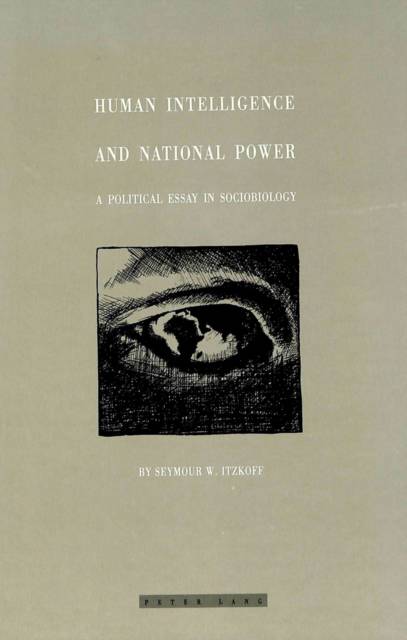
Human Intelligence and National Power
A Political Essay in Sociobiology
Seymour W Itzkoff
Hardcover | Engels
€ 55,95
+ 111 punten
Omschrijving
Human Intelligence and National Power: A political essay in sociobiology discusses the relationship between variable intelligence in ethnic and national cultures and their political impact on the international scene. The books's argument is developed from the theory presented in Dr. Itzkoff's four-volume «Evolution of Human Intelligence», also published by Peter Lang. Each national society to the extent that it reflects a fairly homogeneous ethnicity, also exhibits a unique intellectual profile. Its national intellectual capital is capable through the most advanced forms of education of rising to the capacity for abstract thought and action in meeting the technological requirements of modernity. National corporate intelligence will thus impact on the international community through its economic, military, and political power. The author applies his sociobiological model to the circumstances affecting formerly communist societies, Japan, the United States, the Third World, as well as the broader international scene.
Specificaties
Betrokkenen
- Auteur(s):
- Uitgeverij:
Inhoud
- Aantal bladzijden:
- 258
- Taal:
- Engels
Eigenschappen
- Productcode (EAN):
- 9780820414454
- Verschijningsdatum:
- 1/06/1991
- Uitvoering:
- Hardcover
- Formaat:
- Genaaid
- Afmetingen:
- 236 mm x 160 mm
- Gewicht:
- 519 g


Alleen bij Standaard Boekhandel
+ 111 punten op je klantenkaart van Standaard Boekhandel

Beoordelingen
We publiceren alleen reviews die voldoen aan de voorwaarden voor reviews. Bekijk onze voorwaarden voor reviews.