


- Afhalen na 1 uur in een winkel met voorraad
- Gratis thuislevering in België vanaf € 30
- Ruim aanbod met 7 miljoen producten
- Afhalen na 1 uur in een winkel met voorraad
- Gratis thuislevering in België vanaf € 30
- Ruim aanbod met 7 miljoen producten





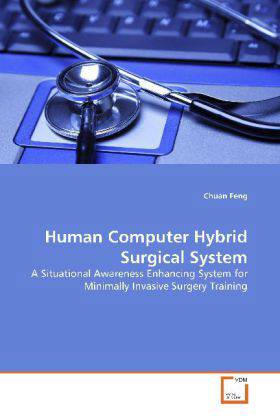
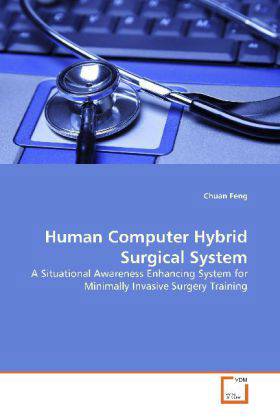
Human Computer Hybrid Surgical System
A Situational Awareness Enhancing System for Minimally Invasive Surgery Training
Chuan Feng
Paperback | Engels
€ 48,45
+ 96 punten
Eenvoudig bestellen
Veilig betalen


Gratis thuislevering vanaf € 30 (via bpost)
Gratis levering in je Standaard Boekhandel
Omschrijving
Minimally Invasive Surgery (MIS) is a surgical technique involving small incisions performed by an endoscope and several long, thin instruments. MIS minimizes complications and speeds up recovery time compared to the traditional surgery. Unfortunately, from a surgeon's perspective, MIS is much more challenging than conventional open surgery because of the limited vision and sensing feedbacks. In the last decade, we have witnessed dramatic increases in performance of computerized assisted system, achieved through increasing computational capabilities and advances in sensor designs. The objective of this research is to design and realize a novel prototype that advances the state of the art in surgical training, assessment, and guidance for MIS. The proposed Situational Awareness Enhancing System (SAES) uses a unified framework incorporating perception, comprehension, and projection software modules that provide feedback during the exercises and enable evaluation of the training procedure. The low cost solution would permit our system to not only measure a trainee's progress in acquiring psychomotor skills, but also to evaluate instrument effectiveness in reducing error.
Specificaties
Betrokkenen
- Auteur(s):
- Uitgeverij:
Inhoud
- Aantal bladzijden:
- 116
- Taal:
- Engels
Eigenschappen
- Productcode (EAN):
- 9783639158571
- Verschijningsdatum:
- 21/05/2009
- Uitvoering:
- Paperback
- Formaat:
- Trade paperback (VS)
- Afmetingen:
- 152 mm x 229 mm
- Gewicht:
- 181 g


Alleen bij Standaard Boekhandel
+ 96 punten op je klantenkaart van Standaard Boekhandel
CADEAU

AANGERADEN


Beoordelingen
We publiceren alleen reviews die voldoen aan de voorwaarden voor reviews. Bekijk onze voorwaarden voor reviews.