


- Afhalen na 1 uur in een winkel met voorraad
- Gratis thuislevering in België vanaf € 30
- Ruim aanbod met 7 miljoen producten
- Afhalen na 1 uur in een winkel met voorraad
- Gratis thuislevering in België vanaf € 30
- Ruim aanbod met 7 miljoen producten





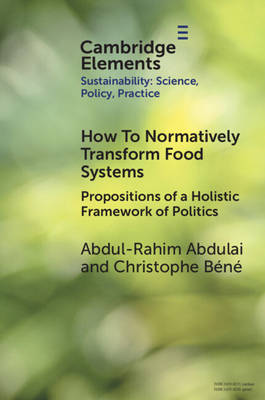
How To Normatively Transform Food Systems
Propositions of a Holistic Framework of Politics
Abdul-Rahim Abdulai, Christophe Béné
€ 24,45
Uitvoering
Omschrijving
Draws from an extensive literature review on food politics to propose a Framework of Holistic Politics for Food System Transformation. The Framework posits that food systems transformation would be a process/outcome of interrelated political configurations of actions across four processes or stages: 1) Identifying resistance to change in the current regime, 2) Creating and sustaining new momentum, 3) Converting new momentum into sustainable options; -and cross-cutting, 4) Managing trade-offs, reducing incoherence, and prioritization. At each stage, four domains of politics must be considered, including 1) Power, the political economy of actors, knowledge, and evidence; 2) Cultural dynamics, norms, and behavior; 3) Capacity and financial resources; and 4) Technological innovations). To deliver normative transformation, these actions must be carried out in four distinct processes. The Framework underscores the need for normative and goal-oriented processes, the multi-dimensionality of politics, and the normative driving environment in governance food systems transformation.
Specificaties
Betrokkenen
- Auteur(s):
- Uitgeverij:
Inhoud
- Aantal bladzijden:
- 144
- Taal:
- Engels
- Reeks:
Eigenschappen
- Productcode (EAN):
- 9781009509619
- Verschijningsdatum:
- 11/09/2025
- Uitvoering:
- Paperback
- Formaat:
- Trade paperback (VS)
- Afmetingen:
- 152 mm x 229 mm
- Gewicht:
- 199 g


Alleen bij Standaard Boekhandel
Cadeau

AANGERADEN


Beoordelingen
We publiceren alleen reviews die voldoen aan de voorwaarden voor reviews. Bekijk onze voorwaarden voor reviews.