


- Afhalen na 1 uur in een winkel met voorraad
- Gratis thuislevering in België vanaf € 30
- Ruim aanbod met 7 miljoen producten
- Afhalen na 1 uur in een winkel met voorraad
- Gratis thuislevering in België vanaf € 30
- Ruim aanbod met 7 miljoen producten





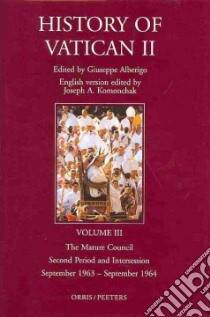
History of Vatican II, Vol. III. the Mature Council. Second Period and Intersession. September 1963 - September 1964
Giuseppe Alberigo
€ 70,00
+ 140 punten
Eenvoudig bestellen
Veilig betalen


Gratis thuislevering vanaf € 30 (via bpost)
Gratis levering in je Standaard Boekhandel
Omschrijving
This third volume of the History of Vatican II describes the period during which the Second Vatican Council began to assume its mature and distinct character. With the succession of Pope Paul VI to Pope John XXIII the Council had a new head. With the revisions of texts accomplished during the firts intersession the council had a new agenda more in line with the desires of the majority that had emerged during the first period. With the appointment of four Moderators the Council had a new leadership. The volume describes the peculiar situation of Paul VI as a pope elected in the midst of an ecumenical council and the vision of the Council - and the Church - that he outlined in his opening speech, which was followed immediately by a consideration of the text on the Church. Both in this discussion and in the one that followed, on bishops, the issue of collegiality would be passionately debated. The Council also completed its work on the first two documents promulgated: the Constitution on the Sacred Liturgy and the Declaration on the Communications Media. The ecumenical commitment of the Council became visible, not only in the discussion of a decree on ecumenism, but in the visit of Paul VI to the Holy Land. During the second intersession the work of the Council continued, the most important features of which were the beginnings of the liturgical reform, the revision of the major texts still to be considered or voted on, and a plan to reduce many other texts to simple sets of propositions that was designed to make it possible for the Council to end with the third period.
Specificaties
Betrokkenen
- Auteur(s):
- Uitgeverij:
Inhoud
- Aantal bladzijden:
- 514
- Taal:
- Engels
- Reeks:
Eigenschappen
- Productcode (EAN):
- 9789042908482
- Verschijningsdatum:
- 7/06/2000
- Uitvoering:
- Hardcover
- Formaat:
- Genaaid
- Afmetingen:
- 168 mm x 246 mm
- Gewicht:
- 1338 g


Alleen bij Standaard Boekhandel
+ 140 punten op je klantenkaart van Standaard Boekhandel
CADEAU

AANGERADEN


Beoordelingen
We publiceren alleen reviews die voldoen aan de voorwaarden voor reviews. Bekijk onze voorwaarden voor reviews.