


- Afhalen na 1 uur in een winkel met voorraad
- Gratis thuislevering in België vanaf € 30
- Ruim aanbod met 7 miljoen producten
- Afhalen na 1 uur in een winkel met voorraad
- Gratis thuislevering in België vanaf € 30
- Ruim aanbod met 7 miljoen producten





€ 111,45
+ 222 punten
Uitvoering
Eenvoudig bestellen
Veilig betalen


Gratis thuislevering vanaf € 30 (via bpost)
Gratis levering in je Standaard Boekhandel
Omschrijving
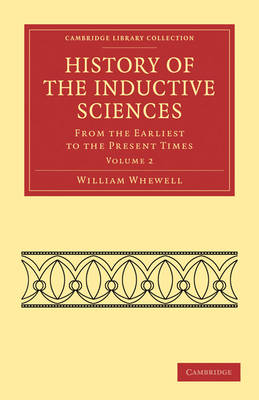
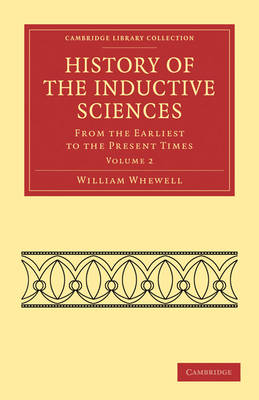
A central figure in Victorian science, William Whewell (1794-1866) held professorships in Mineralogy and Moral Philosophy at Trinity College, Cambridge, before becoming Master of the college in 1841. His mathematical textbooks, such as A Treatise on Dynamics (1823), were instrumental in bringing French analytical methods into British science. This three-volume history, first published in 1837, is one of Whewell's most famous works. Taking the 'acute, but fruitless, essays of Greek philosophy' as a starting point, it provides a history of the physical sciences that culminates with the mechanics, astronomy, and chemistry of 'modern times'. Volume 2 focuses on the rise and development of modern mechanics in the seventeenth century. Whewell shows how Galileo's laws of motion exemplify a paradigmatic shift from 'formal' to 'physical' sciences - a new approach concerned with explaining causes rather than merely observing phenomena. It also discusses the implications for physical astronomy of Newton's discoveries.
Specificaties
Betrokkenen
- Auteur(s):
- Uitgeverij:
Inhoud
- Aantal bladzijden:
- 552
- Taal:
- Engels
- Reeks:
Eigenschappen
- Productcode (EAN):
- 9781108019255
- Verschijningsdatum:
- 9/09/2010
- Uitvoering:
- Paperback
- Formaat:
- Trade paperback (VS)
- Afmetingen:
- 140 mm x 216 mm
- Gewicht:
- 693 g


Alleen bij Standaard Boekhandel
+ 222 punten op je klantenkaart van Standaard Boekhandel
CADEAU

AANGERADEN


Beoordelingen
We publiceren alleen reviews die voldoen aan de voorwaarden voor reviews. Bekijk onze voorwaarden voor reviews.