


- Afhalen na 1 uur in een winkel met voorraad
- Gratis thuislevering in België vanaf € 30
- Ruim aanbod met 7 miljoen producten
- Afhalen na 1 uur in een winkel met voorraad
- Gratis thuislevering in België vanaf € 30
- Ruim aanbod met 7 miljoen producten





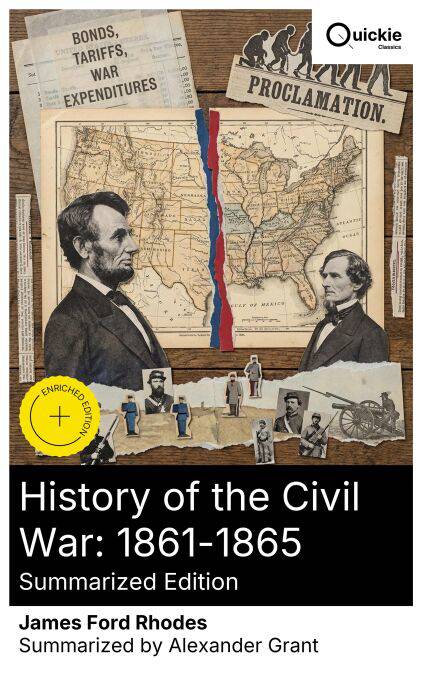
History of the Civil War: 1861-1865 (Summarized Edition) E-BOOK
Enriched edition. From Fort Sumter to Appomattox: Strategy, Emancipation, and Slavery's Central Role in an Evidence-Based Narrative
James Ford Rhodes
E-book | Engels
€ 1,99
+ 1 punten
Omschrijving
History of the Civil War: 1861–1865 delivers a concise, capacious narrative from Fort Sumter to Appomattox, interweaving strategy, politics, and society. Rhodes writes in lucid, judicious prose, privileging documentation over flourish, and sets campaigns beside emancipation, finance, and diplomacy. Working in the early twentieth‑century empiricist tradition, he mines official records and testimony to reconstruct decisions by Lincoln, Davis, Grant, and Lee, while tracing pressures on Union and Confederate home fronts. He makes slavery the conflict's central cause and moral axis. An Ohio industrialist turned independent scholar, James Ford Rhodes left business to pursue history with professional rigor. He combed the Official Records, the Congressional Globe, newspapers, and memoirs, distilling a vast multi‑volume project into this single synthesis. A committed Unionist with a moral critique of slavery, he prized evidence over ornament; the book won the 1918 Pulitzer Prize in History for clarity and comprehensiveness. Readers seeking a masterful overview will find this classic instructive and engrossing. Assign it to students for narrative coherence and a primary‑source backbone, and pair it with newer social and military studies for perspective. For scholars and general readers alike, Rhodes remains a durable guide to the war's leadership, logistics, and meaning.
Quickie Classics summarizes timeless works with precision, preserving the author's voice and keeping the prose clear, fast, and readable—distilled, never diluted. Enriched Edition extras: Introduction · Synopsis · Historical Context · Brief Analysis · 4 Reflection Q&As · Editorial Footnotes.
Quickie Classics summarizes timeless works with precision, preserving the author's voice and keeping the prose clear, fast, and readable—distilled, never diluted. Enriched Edition extras: Introduction · Synopsis · Historical Context · Brief Analysis · 4 Reflection Q&As · Editorial Footnotes.
Specificaties
Betrokkenen
- Auteur(s):
- Uitgeverij:
Inhoud
- Aantal bladzijden:
- 123
- Taal:
- Engels
Eigenschappen
- Productcode (EAN):
- 8596547877776
- Verschijningsdatum:
- 9/01/2026
- Uitvoering:
- E-book
- Beveiligd met:
- Digital watermarking
- Formaat:
- ePub



Alleen bij Standaard Boekhandel
+ 1 punten op je klantenkaart van Standaard Boekhandel
Cadeau

AANGERADEN


Beoordelingen
We publiceren alleen reviews die voldoen aan de voorwaarden voor reviews. Bekijk onze voorwaarden voor reviews.