


- Afhalen na 1 uur in een winkel met voorraad
- Gratis thuislevering in België vanaf € 30
- Ruim aanbod met 7 miljoen producten
- Afhalen na 1 uur in een winkel met voorraad
- Gratis thuislevering in België vanaf € 30
- Ruim aanbod met 7 miljoen producten





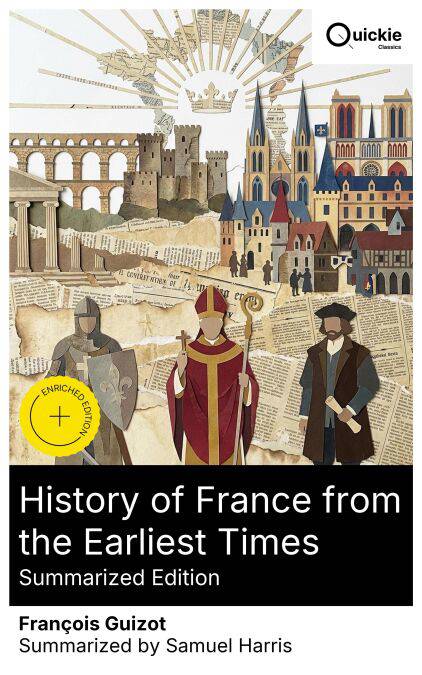
History of France from the Earliest Times (Summarized Edition) E-BOOK
Enriched edition. From Roman Gaul to Capetian and early Valois rule: feudalism, the Church, communes, and the rise of the Third Estate
François Guizot
E-book | Engels
€ 1,99
+ 1 punten
Omschrijving
In History of France from the Earliest Times (Vol. 1–6), François Guizot offers a sweeping narrative from Roman Gaul and the Merovingian and Carolingian kingdoms to the consolidation of Capetian and early Valois monarchy. Weaving chronicles of Gregory of Tours, Einhard, Joinville, Villehardouin, and Froissart with institutional history, he anatomizes feudalism, the Church, communes, and the rising Third Estate. His lucid, didactic prose and moral analysis place events within a Whiggish arc toward royal centralization and civic liberty, characteristic of nineteenth-century liberal historiography. A Protestant from Nîmes whose father perished in the Terror, Guizot became the Sorbonne's most influential lecturer before serving as minister and ultimately prime minister under the July Monarchy. His doctrine of the juste milieu and his lectures on European civilization inform this work's emphasis on institutions, constitutional moderation, and the social ascent of the bourgeoisie. Scholars and general readers alike will value these volumes as a foundational statement of French national history and a key document of nineteenth-century historical method. Read it for its elegant synthesis, its command of sources, and its argued teleology—while recognizing its period assumptions. It remains an indispensable gateway to France's longue durée.
Quickie Classics summarizes timeless works with precision, preserving the author's voice and keeping the prose clear, fast, and readable—distilled, never diluted. Enriched Edition extras: Introduction · Synopsis · Historical Context · Brief Analysis · 4 Reflection Q&As · Editorial Footnotes.
Quickie Classics summarizes timeless works with precision, preserving the author's voice and keeping the prose clear, fast, and readable—distilled, never diluted. Enriched Edition extras: Introduction · Synopsis · Historical Context · Brief Analysis · 4 Reflection Q&As · Editorial Footnotes.
Specificaties
Betrokkenen
- Auteur(s):
- Illustrator(s):
- Vertaler(s):
- Uitgeverij:
Inhoud
- Aantal bladzijden:
- 766
- Taal:
- Engels
Eigenschappen
- Productcode (EAN):
- 8596547877745
- Verschijningsdatum:
- 09/01/2026
- Uitvoering:
- E-book
- Beveiligd met:
- Digital watermarking
- Formaat:
- ePub


Alleen bij Standaard Boekhandel
+ 1 punten op je klantenkaart van Standaard Boekhandel
Cadeau

AANGERADEN


Beoordelingen
We publiceren alleen reviews die voldoen aan de voorwaarden voor reviews. Bekijk onze voorwaarden voor reviews.