


- Afhalen na 1 uur in een winkel met voorraad
- Gratis thuislevering in België vanaf € 30
- Ruim aanbod met 7 miljoen producten
- Afhalen na 1 uur in een winkel met voorraad
- Gratis thuislevering in België vanaf € 30
- Ruim aanbod met 7 miljoen producten





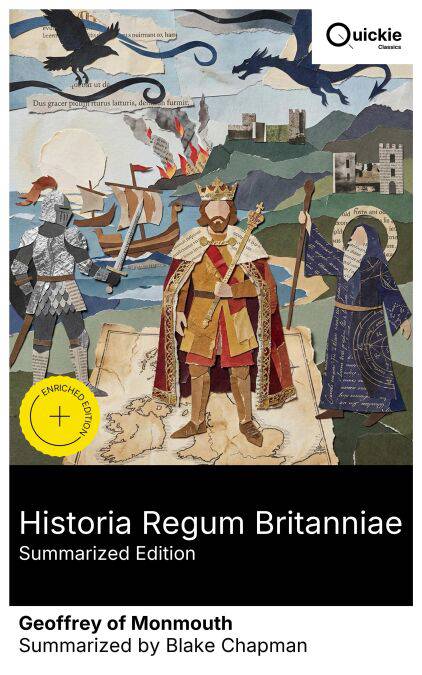
Historia Regum Britanniae (Summarized Edition) E-BOOK
Enriched edition. From Trojan Origins to Arthurian Legends: A Pseudohistorical Chronicle of Britain's Ancient Kings
Geoffrey of Monmouth
E-book | Engels
€ 1,99
+ 1 punten
Omschrijving
Composed c. 1136, Geoffrey of Monmouth's Historia regum Britanniae narrates Britain's kings from the Trojan Brutus to Cadwaladr, with its fulcrum the rise and eclipse of Arthur and the oracles of Merlin. In ornate Latin that fuses annal, epic episode, and rhetorical speeches, Geoffrey adapts learned historiography to legend, reworking Gildas, Bede, and Nennius while claiming a British source, inaugurating Europe's durable Arthurian myth-history. Of Geoffrey himself we know little: a cleric from the Welsh–Norman marches, later bishop of St Asaph (1152), active in the Oxford milieu and author also of Prophetiae Merlini and Vita Merlini. Writing under patrons such as Robert, earl of Gloucester, and amid the Anarchy, he fashioned a usable antiquity to reconcile British memory with Anglo-Norman power. This is essential reading for students of medieval historiography, Arthurian literature, and the politics of origin. Read it as literature and program, not archive: attend to Geoffrey's source-play, his set-piece rhetoric, and his vision of empire. A reliable critical translation with notes will richly reward close, comparative study.
Quickie Classics summarizes timeless works with precision, preserving the author's voice and keeping the prose clear, fast, and readable—distilled, never diluted. Enriched Edition extras: Introduction · Synopsis · Historical Context · Brief Analysis · 4 Reflection Q&As · Editorial Footnotes.
Quickie Classics summarizes timeless works with precision, preserving the author's voice and keeping the prose clear, fast, and readable—distilled, never diluted. Enriched Edition extras: Introduction · Synopsis · Historical Context · Brief Analysis · 4 Reflection Q&As · Editorial Footnotes.
Specificaties
Betrokkenen
- Auteur(s):
- Uitgeverij:
Inhoud
- Aantal bladzijden:
- 116
- Taal:
- Engels
Eigenschappen
- Productcode (EAN):
- 8596547880844
- Verschijningsdatum:
- 9/01/2026
- Uitvoering:
- E-book
- Beveiligd met:
- Digital watermarking
- Formaat:
- ePub


Alleen bij Standaard Boekhandel
+ 1 punten op je klantenkaart van Standaard Boekhandel

Beoordelingen
We publiceren alleen reviews die voldoen aan de voorwaarden voor reviews. Bekijk onze voorwaarden voor reviews.