


- Afhalen na 1 uur in een winkel met voorraad
- Gratis thuislevering in België vanaf € 30
- Ruim aanbod met 7 miljoen producten
- Afhalen na 1 uur in een winkel met voorraad
- Gratis thuislevering in België vanaf € 30
- Ruim aanbod met 7 miljoen producten





Omschrijving
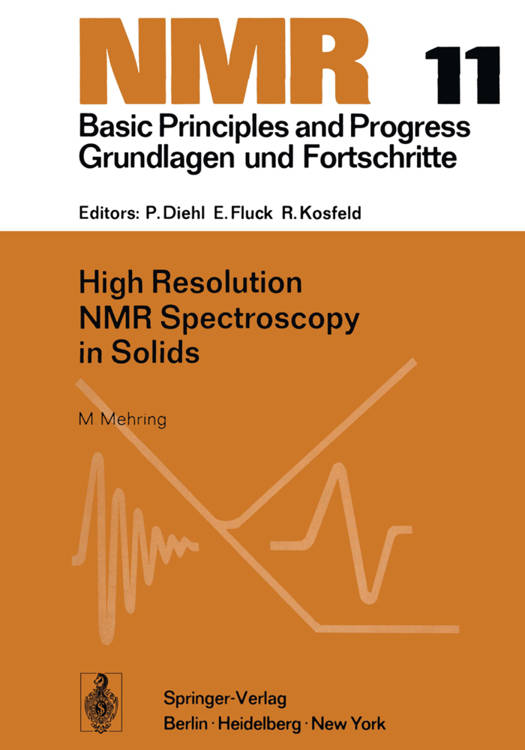
Manipulation and Dilution Tools for Ruling Abundant Species "NMR is dead" was the slogan heard in the late 1960s at least among physicists, until John S. Waugh and his co-workers initiated a series of new NMR experiments, which employed the coherent modulation of interactions by strong radiofrequency fields. A wealth of new phenomena was observed, which are summarized in the introduction for the convenience of the unbiased reader, whereas Section 2 collects the basic spin interactions observed in solids. Line-narrowing effects in dipolar coupled solids by the application of multiple- pulse experiments are extensively discussed in Section 3. Numerous extensions of the basic Waugh, Huber, and Haeberlen experiment have been developed by different groups and have been applied to the nuclei IH, 9Be, 19F, 27Al, 31p, 63CU in solids. Application of this technique to a variety of systems is still in progress and should reveal interesting insights into weak spin interactions in solids. It was soon realized that rare spins could be used as monitors for molecular fields in the solid state; however, rare spin observation is difficult because of the small signal-to-noise ratio. Pines, Gibby, and Waugh introduced a new concept of cross-polarization, based on ideas of Hahn and co-workers, which allows the detection ofrare spins with increased sensitivity. The dynamics involved are treated in detail. Other sections merely list results obtained by the techniques described and demonstrate their usefulness in the investigation of dynamical problems in molec- ular and solid state physics.
Specificaties
Betrokkenen
- Auteur(s):
- Uitgeverij:
Inhoud
- Aantal bladzijden:
- 248
- Taal:
- Engels
- Reeks:
- Reeksnummer:
- nr. 11
Eigenschappen
- Productcode (EAN):
- 9783642963346
- Verschijningsdatum:
- 21/01/2012
- Uitvoering:
- Paperback
- Formaat:
- Trade paperback (VS)
- Afmetingen:
- 170 mm x 244 mm
- Gewicht:
- 426 g


Alleen bij Standaard Boekhandel
+ 300 punten op je klantenkaart van Standaard Boekhandel
Wedstrijd


Beoordelingen
We publiceren alleen reviews die voldoen aan de voorwaarden voor reviews. Bekijk onze voorwaarden voor reviews.