


- Afhalen na 1 uur in een winkel met voorraad
- Gratis thuislevering in België vanaf € 30
- Ruim aanbod met 7 miljoen producten
- Afhalen na 1 uur in een winkel met voorraad
- Gratis thuislevering in België vanaf € 30
- Ruim aanbod met 7 miljoen producten





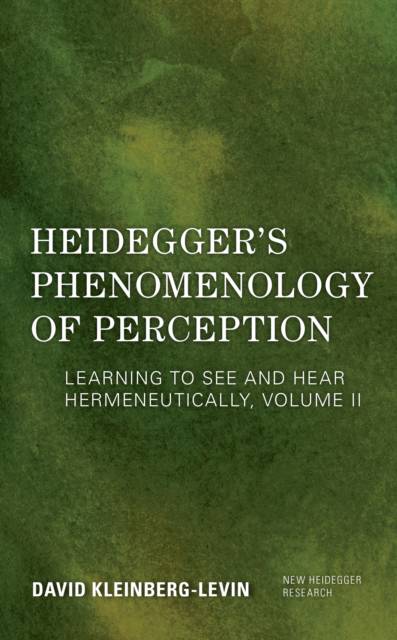
Heidegger's Phenomenology of Perception
Learning to See and Hear Hermeneutically
David Kleinberg-Levin
€ 271,45
+ 542 punten
Uitvoering
Omschrijving
In volume I, Kleinberg-Levin interprets five key words in Heidegger's project. In this second volume, he illuminates their significance for Heidegger's phenomenology of perception and his philosophy of history. At stake is the possibility of a new experience and understanding of being. Taking us beyond the metaphysical understanding of being, Heidegger proposes to introduce a new key word Seyn (beyng). Beyng is the Da-sein-appropriating event in which a clearing occurs as an open dimension for the time-space interplay of concealment and unconcealment, an interplay within which beings are experienced in regard to the various modes and inflections of presence and absence that the grammar of temporalities articulates. Concentrating on the appropriation of seeing and hearing as capacities and capabilities bearing promising potentialities that could be developed, Kleinberg-Levin examines seeing and hearing in the context of Heidegger's critique of the history of metaphysics, wherein vision has served as paradigm for knowledge, truth, and reality. He shows that, in Heidegger's philosophy of history, seeing and hearing are given a role in the transformation of the character of humanity, redeeming their own inherent potential. Perceptual experience has undergone accelerating processes of deformation and reification, encouraging a disposition that makes it serve technological and technocratic imperatives; but we might begin to redeem the promising potential in seeing and hearing, turning their damaged and dehumanized character, and their violence, towards the creation of a new planetary existence--what Heidegger imagines through the topology of the fourfold: earth and sky, mortals and the gods who embody our ideals. In this project, we are put in question by a responsibility that summons us, in our seeing and hearing, to the response-abilities most befitting our historically shared sense of an achieved humanity.
Specificaties
Betrokkenen
- Auteur(s):
- Uitgeverij:
Inhoud
- Aantal bladzijden:
- 380
- Taal:
- Engels
- Reeks:
Eigenschappen
- Productcode (EAN):
- 9781786612144
- Verschijningsdatum:
- 10/12/2020
- Uitvoering:
- Hardcover
- Formaat:
- Genaaid
- Afmetingen:
- 152 mm x 229 mm
- Gewicht:
- 730 g


Alleen bij Standaard Boekhandel
+ 542 punten op je klantenkaart van Standaard Boekhandel
Cadeau

AANGERADEN


Beoordelingen
We publiceren alleen reviews die voldoen aan de voorwaarden voor reviews. Bekijk onze voorwaarden voor reviews.