



Je cadeautjes zeker op tijd in huis hebben voor de feestdagen? Kom langs in onze winkels en vind het perfecte geschenk!
- Afhalen na 1 uur in een winkel met voorraad
- Gratis thuislevering in België vanaf € 30
- Ruim aanbod met 7 miljoen producten
Je cadeautjes zeker op tijd in huis hebben voor de feestdagen? Kom langs in onze winkels en vind het perfecte geschenk!
- Afhalen na 1 uur in een winkel met voorraad
- Gratis thuislevering in België vanaf € 30
- Ruim aanbod met 7 miljoen producten





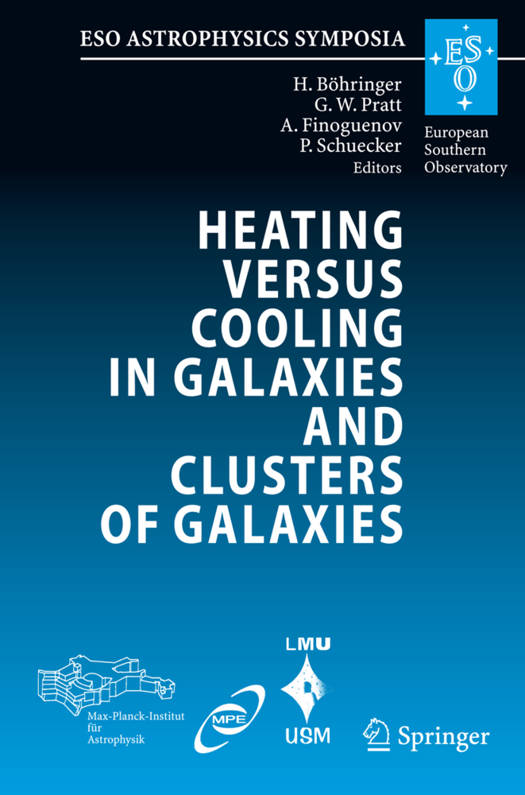
Heating Versus Cooling in Galaxies and Clusters of Galaxies
Proceedings of the Mpa/Eso/Mpe/Usm Joint Astronomy Conference Held in Garching, Germany, 6-11 August 2006
€ 83,95
+ 167 punten
Omschrijving
The Universe would be a dull and dark place if the gaseous baryons did not cool, collapse, and form stars and galaxies. However, if this gas is allowed to cool unimpeded at the rate predicted from known atomic physics, in the context of a well-established cosmological model, the gaseous matter would form stars and galaxies with a high e?ciency, so that far more than the observed fraction of about 10-15% of the baryonic matter would be found in luminous stellar systems. Therefore, cooling must be damped or regulatedby heating processes, and observations show that this 'feedback' is a widespread astrophysical phenomenon. The place where this cooling and feedback manifests itself most dram- ically is in the inner regions of the most massive Dark Matter halos found in our Universe, in the cores of galaxy clusters. The e?ect of cosmic co- ing in these objects was recognized in the mid-1970s, and the term 'cooling ?ow' was introduced by Andy Fabian and colleagues at Cambridge as a p- sible explanation of the physical processes obtained in the central regions of clusters. The name refers to the fact that gas cooling in the inner regions is associated with a loss of central pressure, causing an in?ow of hot gas from larger radii.
Specificaties
Betrokkenen
- Uitgeverij:
Inhoud
- Aantal bladzijden:
- 445
- Taal:
- Engels
- Reeks:
Eigenschappen
- Productcode (EAN):
- 9783642092572
- Verschijningsdatum:
- 23/11/2010
- Uitvoering:
- Paperback
- Formaat:
- Trade paperback (VS)
- Afmetingen:
- 156 mm x 234 mm
- Gewicht:
- 653 g

Alleen bij Standaard Boekhandel
+ 167 punten op je klantenkaart van Standaard Boekhandel
CADEAU


Beoordelingen
We publiceren alleen reviews die voldoen aan de voorwaarden voor reviews. Bekijk onze voorwaarden voor reviews.