


- Afhalen na 1 uur in een winkel met voorraad
- Gratis thuislevering in België vanaf € 30
- Ruim aanbod met 7 miljoen producten
- Afhalen na 1 uur in een winkel met voorraad
- Gratis thuislevering in België vanaf € 30
- Ruim aanbod met 7 miljoen producten





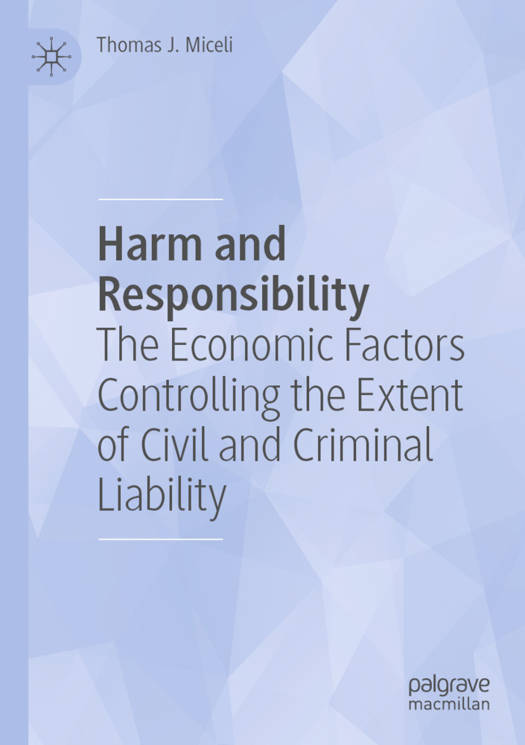
Harm and Responsibility
The Economic Factors Controlling the Extent of Civil and Criminal Liability.DE
Thomas J. Miceli
Paperback | Engels
€ 129,95
Omschrijving
Risk is an ever-present feature of life in a complex world, and it is important for societies to manage it in a just and efficient manner. One way to reduce risk is to assign responsibility for the associated harm. In this book, economist Thomas J. Miceli examines harm and responsibility from an economic perspective.
The book focuses on how responsibility affects people's incentives to refrain from causing unnecessary harm to achieve what economists call optimal deterrence. Secondarily, it is concerned with the quest for justice. Defining this is part of the journey. Does it mean compensating victims for unavoidable losses? Does it involve punishing wrongdoers in proportion to the harm they have caused? Is there a clear answer? The book addresses these questions and more, explaining how, in some cases, these objectives will align with deterrence and in others they will not. The book discusses the ways that the law, tempered by religious and social norms, strikes a balance between these goals.
The principal areas of law that assign legal responsibility are tort law (for accidental harms) and criminal law (for intentional harms). There exist vibrant economic theories of both, and this volume draws on this literature. One theme that emerges is the role of causation in determining responsibility. Attributing responsibility for a given harm to the party that caused it seems both morally just (because it embodies personal responsibility), and economically desirable (because it achieves deterrence in the most direct manner). And yet the law departs from this prescription in any number of ways, both by limiting the responsibility of some who caused harm and by expanding responsibility to some who did not. The book offers readers coherent economic explanations for these departures from a purely causal basis for legal responsibility.
Author Thomas J. Miceli clarifies causation as reciprocal in nature and therefore not a uniquely defined concept. This means that when an action by A causes harm to B, the question is not how to restrain A but rather: whether A has the legal right to take the action in question or whether B has the right to prevent it. There will be a harm either way; the relevant question is which party should bear it. This insight ultimately leads to the fundamental problem of defining harm. In most conflicts this can be straightforward-as when A punches B-but in others it is more challenging. For example, when does free speech become hate speech? Where is the line drawn?
The book concludes by drawing out the implications of this fundamental ambiguity over the meaning of harm, what that means for the law, and what economic theory has to say about it.
Specificaties
Betrokkenen
- Auteur(s):
- Uitgeverij:
Inhoud
- Taal:
- Engels
Eigenschappen
- Productcode (EAN):
- 9783031748332
- Uitvoering:
- Paperback
- Afmetingen:
- 148 mm x 15 mm
- Gewicht:
- 376 g


Alleen bij Standaard Boekhandel
AANGERADEN


Beoordelingen
We publiceren alleen reviews die voldoen aan de voorwaarden voor reviews. Bekijk onze voorwaarden voor reviews.