


- Afhalen na 1 uur in een winkel met voorraad
- Gratis thuislevering in België vanaf € 30
- Ruim aanbod met 7 miljoen producten
- Afhalen na 1 uur in een winkel met voorraad
- Gratis thuislevering in België vanaf € 30
- Ruim aanbod met 7 miljoen producten





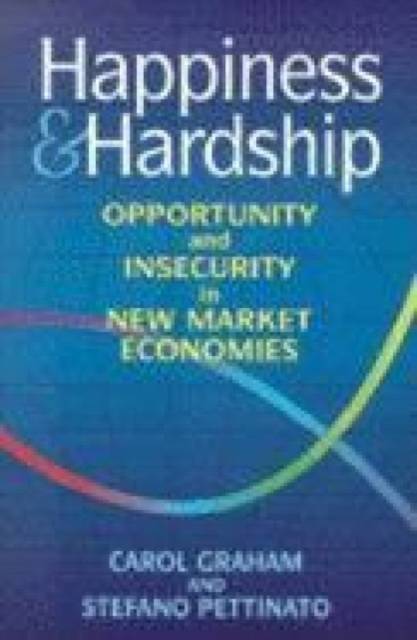
Happiness and Hardship
Opportunity and Insecurity in New Market Economies
Carol L Graham, Stefano Pettinato
Paperback | Engels
€ 42,45
+ 84 punten
Omschrijving
Subjective well being, or happiness, has been analyzed in detail by psychologists for decades. Yet only recently has it become the subject of economic analysis. In Happiness and Hardship, Carol Graham and Stefano Pettinato provide a new conceptual framework for analyzing the relationship between subjective well being and the political sustainability of market-oriented economic growth in 17 Latin American countries and Russia. Several variables--such as marital status, employment, and inflation--are known to influence happiness. Graham and Pettinato have identified other variables that have important effects on how individuals perceive their well being: macroeconomic volatility, globalization of information, increasing income mobility, and inequality driven by technology-led growth. The authors begin by explaining data and measurement problems involved in studying mobility, and they summarize general trends in developing countries. Second, they provide new data on subjective well being for Latin America and Russia. They find that the socio-demographic determinants of ""happiness""--such as the effects of age and unemployment--are very similar to those in the U.S. and Europe. They also find that relative income differences have important effects on how individuals assess their well being. Those in the middle or lower middle of the income distribution are more likely to be dissatisfied than are the very poorest groups. Third, the authors find that volatility in income flows can have negative effects on perceived well being, even among upwardly mobile individuals. Finally, the authors explore the relationship between social capital and mobility. They distinguish between participation driven by economic necessity--such as soup kitchens--and voluntary participation in civic organizations. They find that different objectives underlying civic participation can result in different effects on individual mobility rates, on perceived well being, and on aggregate growth. An
Specificaties
Betrokkenen
- Auteur(s):
- Uitgeverij:
Inhoud
- Aantal bladzijden:
- 190
- Taal:
- Engels
Eigenschappen
- Productcode (EAN):
- 9780815702412
- Verschijningsdatum:
- 1/12/2001
- Uitvoering:
- Paperback
- Formaat:
- Trade paperback (VS)
- Afmetingen:
- 150 mm x 231 mm
- Gewicht:
- 263 g


Alleen bij Standaard Boekhandel
+ 84 punten op je klantenkaart van Standaard Boekhandel
Cadeau

AANGERADEN


Beoordelingen
We publiceren alleen reviews die voldoen aan de voorwaarden voor reviews. Bekijk onze voorwaarden voor reviews.