


- Afhalen na 1 uur in een winkel met voorraad
- Gratis thuislevering in België vanaf € 30
- Ruim aanbod met 7 miljoen producten
- Afhalen na 1 uur in een winkel met voorraad
- Gratis thuislevering in België vanaf € 30
- Ruim aanbod met 7 miljoen producten





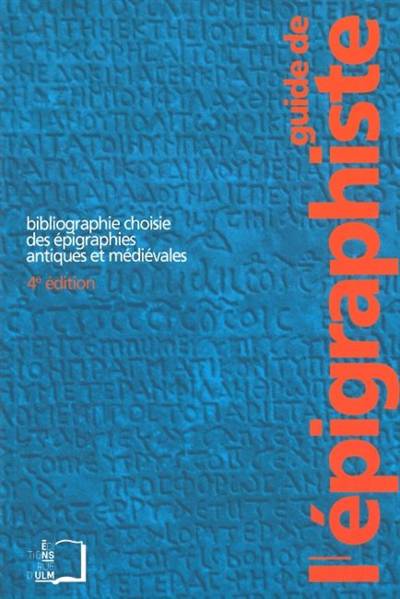
Guide de l'épigraphiste
bibliographie choisie des épigraphies antiques et médiévales
François Bérard, Nicolas Laubry, Denis Rousset
Paperback | Frans
€ 30,50
+ 61 punten
Omschrijving
L’épigraphie fait peur.
Historiens, linguistes, archéologues en connaissent l’intérêt : ils ont quelquefois peine à s’y retrouver. Les pierres inscrites jouaient en effet, dans la cité antique, un rôle infiniment plus grand et plus divers que de nos jours, et c’est par milliers qu’on a conservé des inscriptions grecques et latines – dont le nombre s’accroît chaque année grâce à de nouvelles découvertes. Où trouver les inscriptions sorties du sol italien depuis la parution du Corpus Inscriptionum Latinarum ? L’édition la plus autorisée de la pierre de Rosette ou de l’édit de Dioclétien ? Les répertoires prosopographiques qui permettront d’engager une première étude d’histoire sociale ?
Pour aider à répondre à de telles questions, un groupe de chercheurs liés à l’ENS à réuni cette bibliographie sélective, dévoilant au profane les principales clefs de la science épigraphique, et le conduisant du monde gréco-romain aux autres peuples du pourtour méditerranéen et de sa périphérie plus lointaine. Cette quatrième édition, entièrement refondue, compte quelque 3 000 notices, dont plus du quart signale des publications parues depuis l’édition précédente.
Synopsis
Epigraphy is a scary subject. Historians, linguists and archaeologists are well aware of its diversity and it may be difficult for them to find their way. Inscripted stones from the ancient times performed a wide variety of functions, and had an importance which is difficult for us to appreciate now. Thousand of Greek and Latin texts survived and each year the number increases thanks to new discoveries.
How can one trace inscriptions discovered in Italy since the publication of Corpus Inscriptionum Latinarum ? Find the most reliable edition of the Rosetta Stone or Diocletian’s Edict ? Discover the prosopographical informations that will enable the study of social relations ?
To deal with such questions, in 1986, a group of French scholars produced the first edition of this Guide, revealing the keys to the study of the epigraphies, taking its reader through the Greco-roman world and its mediterranean neighbouring countries.
This fourth edition is a completely new work and proposes 2975 items.
Historiens, linguistes, archéologues en connaissent l’intérêt : ils ont quelquefois peine à s’y retrouver. Les pierres inscrites jouaient en effet, dans la cité antique, un rôle infiniment plus grand et plus divers que de nos jours, et c’est par milliers qu’on a conservé des inscriptions grecques et latines – dont le nombre s’accroît chaque année grâce à de nouvelles découvertes. Où trouver les inscriptions sorties du sol italien depuis la parution du Corpus Inscriptionum Latinarum ? L’édition la plus autorisée de la pierre de Rosette ou de l’édit de Dioclétien ? Les répertoires prosopographiques qui permettront d’engager une première étude d’histoire sociale ?
Pour aider à répondre à de telles questions, un groupe de chercheurs liés à l’ENS à réuni cette bibliographie sélective, dévoilant au profane les principales clefs de la science épigraphique, et le conduisant du monde gréco-romain aux autres peuples du pourtour méditerranéen et de sa périphérie plus lointaine. Cette quatrième édition, entièrement refondue, compte quelque 3 000 notices, dont plus du quart signale des publications parues depuis l’édition précédente.
Synopsis
Epigraphy is a scary subject. Historians, linguists and archaeologists are well aware of its diversity and it may be difficult for them to find their way. Inscripted stones from the ancient times performed a wide variety of functions, and had an importance which is difficult for us to appreciate now. Thousand of Greek and Latin texts survived and each year the number increases thanks to new discoveries.
How can one trace inscriptions discovered in Italy since the publication of Corpus Inscriptionum Latinarum ? Find the most reliable edition of the Rosetta Stone or Diocletian’s Edict ? Discover the prosopographical informations that will enable the study of social relations ?
To deal with such questions, in 1986, a group of French scholars produced the first edition of this Guide, revealing the keys to the study of the epigraphies, taking its reader through the Greco-roman world and its mediterranean neighbouring countries.
This fourth edition is a completely new work and proposes 2975 items.
Specificaties
Betrokkenen
- Auteur(s):
- Uitgeverij:
Inhoud
- Aantal bladzijden:
- 448
- Taal:
- Frans
Eigenschappen
- Productcode (EAN):
- 9782728804436
- Verschijningsdatum:
- 30/09/2010
- Uitvoering:
- Paperback
- Afmetingen:
- 160 mm x 240 mm
- Gewicht:
- 700 g


Alleen bij Standaard Boekhandel
+ 61 punten op je klantenkaart van Standaard Boekhandel
Wedstrijd


Beoordelingen
We publiceren alleen reviews die voldoen aan de voorwaarden voor reviews. Bekijk onze voorwaarden voor reviews.