


- Afhalen na 1 uur in een winkel met voorraad
- Gratis thuislevering in België vanaf € 30
- Ruim aanbod met 7 miljoen producten
- Afhalen na 1 uur in een winkel met voorraad
- Gratis thuislevering in België vanaf € 30
- Ruim aanbod met 7 miljoen producten





€ 86,45
+ 172 punten
Omschrijving
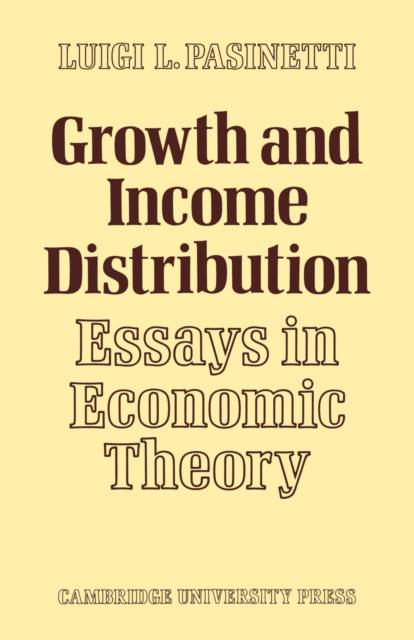
This 1974 collection of six essays in economic theory represents a major contribution to the field. The first contains the formulation of the Ricardian system, whilst the next two contain, respectively, the author's synthetic treatment of the complex problems of fluctuations and economic growth, and his well-known theorem that in the long run the rate of profit and income distribution are independent of the propensities to save of the working class. The essays that follow provide the missing links: a coherent picture of the macroeconomic theories that have originated in Cambridge and a discussion of their deep foundations in classical economic analysis. Finally, the author evaluates some economic controversies and draws his conclusions on the basic forces determining rate of profit in the process of economic growth. Although the arguments are highly theoretical, they require no knowledge of mathematics beyond elementary calculus and algebra.
Specificaties
Betrokkenen
- Auteur(s):
- Uitgeverij:
Inhoud
- Aantal bladzijden:
- 164
- Taal:
- Engels
Eigenschappen
- Productcode (EAN):
- 9780521295437
- Verschijningsdatum:
- 1/03/1979
- Uitvoering:
- Paperback
- Formaat:
- Trade paperback (VS)
- Afmetingen:
- 140 mm x 216 mm
- Gewicht:
- 213 g


Alleen bij Standaard Boekhandel
+ 172 punten op je klantenkaart van Standaard Boekhandel
CADEAU

AANGERADEN


Beoordelingen
We publiceren alleen reviews die voldoen aan de voorwaarden voor reviews. Bekijk onze voorwaarden voor reviews.