


- Afhalen na 1 uur in een winkel met voorraad
- Gratis thuislevering in België vanaf € 30
- Ruim aanbod met 7 miljoen producten
- Afhalen na 1 uur in een winkel met voorraad
- Gratis thuislevering in België vanaf € 30
- Ruim aanbod met 7 miljoen producten





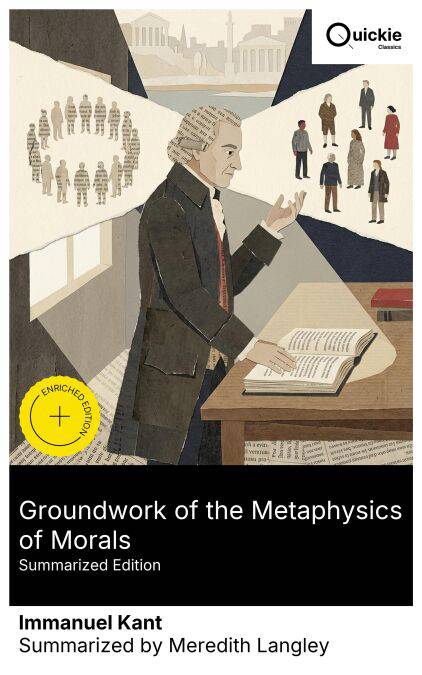
Groundwork of the Metaphysics of Morals (Summarized Edition) E-BOOK
Enriched edition. Ethical reasoning and the categorical imperative: duty vs. inclination in Enlightenment moral philosophy
Immanuel Kant
E-book | Engels
€ 1,99
+ 1 punten
Omschrijving
Groundwork of the Metaphysics of Morals (1785) seeks the supreme principle of morality by moving from common moral cognition to a pure metaphysics of morals. In dense, architectonic prose, Kant distinguishes acting from duty from mere conformity, elevates the good will, and articulates the Categorical Imperative in its core formulations—Universal Law, Humanity as End, and the Kingdom of Ends—grounding obligation in autonomy. Situated in the Enlightenment, it counters sentimentalist and consequentialist ethics, anticipates the Critique of Practical Reason, and recasts natural-law debates in rigorously deontological terms. Immanuel Kant (1724–1804), the Königsberg philosopher of strict habits and sweeping ambitions, composed the Groundwork during his critical turn, seeking an a priori basis for morality akin to that which the first Critique won for science. Shaped by Pietist education, Newtonian science, and a humanistic commitment to Sapere aude, he forged a conception of freedom as self-legislation that made dignity and respect central to ethics. Students of ethics, law, and political theory will find here a stringent standard for moral judgment. Read slowly, trace the argument's definitions, and attend to autonomy; the Groundwork remains an indispensable portal to modern moral philosophy.
Quickie Classics summarizes timeless works with precision, preserving the author's voice and keeping the prose clear, fast, and readable—distilled, never diluted. Enriched Edition extras: Introduction · Synopsis · Historical Context · Author Biography · Brief Analysis · 4 Reflection Q&As · Editorial Footnotes.
Quickie Classics summarizes timeless works with precision, preserving the author's voice and keeping the prose clear, fast, and readable—distilled, never diluted. Enriched Edition extras: Introduction · Synopsis · Historical Context · Author Biography · Brief Analysis · 4 Reflection Q&As · Editorial Footnotes.
Specificaties
Betrokkenen
- Auteur(s):
- Vertaler(s):
- Uitgeverij:
Inhoud
- Aantal bladzijden:
- 62
- Taal:
- Engels
Eigenschappen
- Productcode (EAN):
- 8596547883920
- Verschijningsdatum:
- 9/01/2026
- Uitvoering:
- E-book
- Beveiligd met:
- Digital watermarking
- Formaat:
- ePub


Alleen bij Standaard Boekhandel
+ 1 punten op je klantenkaart van Standaard Boekhandel
AANGERADEN


Beoordelingen
We publiceren alleen reviews die voldoen aan de voorwaarden voor reviews. Bekijk onze voorwaarden voor reviews.