


- Afhalen na 1 uur in een winkel met voorraad
- Gratis thuislevering in België vanaf € 30
- Ruim aanbod met 7 miljoen producten
- Afhalen na 1 uur in een winkel met voorraad
- Gratis thuislevering in België vanaf € 30
- Ruim aanbod met 7 miljoen producten





€ 36,45
+ 72 punten
Omschrijving
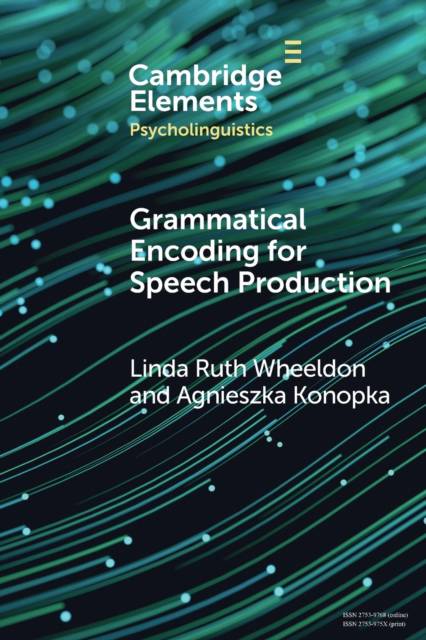
During the production of spoken sentences, the linearisation of a 'thought' is accomplished via the process of grammatical encoding, i.e., the building of a hierarchical syntactic frame that fixes the linear order of lexical concepts. While much research has demonstrated the independence of lexical and syntactic representations, exactly what is represented remains a matter of dispute. Moreover, theories differ in terms of whether words or syntax drive grammatical encoding. This debate is also central to theories of the time-course of grammatical encoding. Speaking is usually a rapid process in which articulation begins before an utterance has been entirely planned. Current theories of grammatical encoding make different claims about the scope of grammatical encoding prior to utterance onset, and the degree to which planning scope is determined by linguistic structure or by cognitive factors. The authors review current theories of grammatical encoding and evaluate them in light of relevant empirical evidence. This title is also available as Open Access on Cambridge Core.
Specificaties
Betrokkenen
- Auteur(s):
- Uitgeverij:
Inhoud
- Aantal bladzijden:
- 84
- Taal:
- Engels
- Reeks:
Eigenschappen
- Productcode (EAN):
- 9781009264556
- Verschijningsdatum:
- 30/03/2023
- Uitvoering:
- Paperback
- Formaat:
- Trade paperback (VS)
- Afmetingen:
- 152 mm x 229 mm
- Gewicht:
- 122 g


Alleen bij Standaard Boekhandel
+ 72 punten op je klantenkaart van Standaard Boekhandel
Cadeau

AANGERADEN


Beoordelingen
We publiceren alleen reviews die voldoen aan de voorwaarden voor reviews. Bekijk onze voorwaarden voor reviews.