


- Afhalen na 1 uur in een winkel met voorraad
- Gratis thuislevering in België vanaf € 30
- Ruim aanbod met 7 miljoen producten
- Afhalen na 1 uur in een winkel met voorraad
- Gratis thuislevering in België vanaf € 30
- Ruim aanbod met 7 miljoen producten





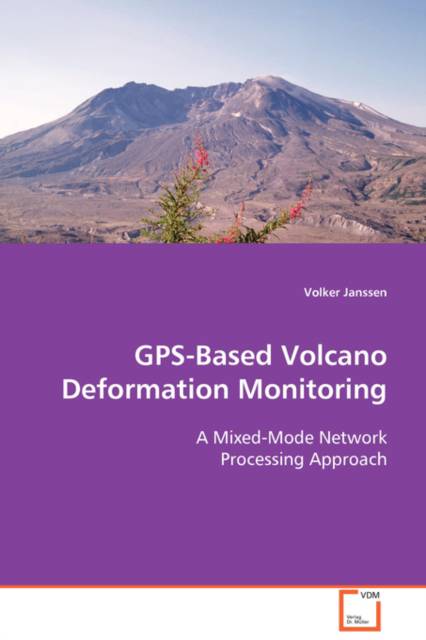
GPS-Based Volcano Deformation Monitoring
A Mixed-Mode Network Processing Approach
Volker Janssen
Paperback | Engels
€ 86,45
+ 172 punten
Omschrijving
Ground surface deformation at a volcano is
recognised as a sure indicator of impending eruptive
activity and can contribute to volcanic hazard
mitigation and disaster risk management. The Global
Positioning System (GPS) is ideally suited for
detecting and monitoring such deformation. However,
most volcanoes are located in the equatorial region
where the highly disturbed ionosphere severely
limits the accuracy achievable with low-cost,
single-frequency GPS networks. This book reviews the
characteristics of continuously operating GPS
deformation monitoring networks and describes a
mixed-mode GPS network approach used to optimise a
low-cost deformation monitoring system on an active
Indonesian volcano. A sparse network of GPS
receivers surrounding the deformation zone models
the regional ionosphere, and empirical corrections
are applied to the inner deformation network in
order to improve the achievable accuracy. This
approach is suitable for a variety of applications,
including both natural and man-made structures, and
will be particularly useful for researchers and
spatial professionals concerned with cost-effective
and accurate deformation monitoring.
recognised as a sure indicator of impending eruptive
activity and can contribute to volcanic hazard
mitigation and disaster risk management. The Global
Positioning System (GPS) is ideally suited for
detecting and monitoring such deformation. However,
most volcanoes are located in the equatorial region
where the highly disturbed ionosphere severely
limits the accuracy achievable with low-cost,
single-frequency GPS networks. This book reviews the
characteristics of continuously operating GPS
deformation monitoring networks and describes a
mixed-mode GPS network approach used to optimise a
low-cost deformation monitoring system on an active
Indonesian volcano. A sparse network of GPS
receivers surrounding the deformation zone models
the regional ionosphere, and empirical corrections
are applied to the inner deformation network in
order to improve the achievable accuracy. This
approach is suitable for a variety of applications,
including both natural and man-made structures, and
will be particularly useful for researchers and
spatial professionals concerned with cost-effective
and accurate deformation monitoring.
Specificaties
Betrokkenen
- Auteur(s):
- Uitgeverij:
Inhoud
- Aantal bladzijden:
- 160
- Taal:
- Engels
Eigenschappen
- Productcode (EAN):
- 9783639112764
- Verschijningsdatum:
- 16/12/2008
- Uitvoering:
- Paperback
- Formaat:
- Trade paperback (VS)
- Afmetingen:
- 152 mm x 229 mm
- Gewicht:
- 222 g



Alleen bij Standaard Boekhandel
+ 172 punten op je klantenkaart van Standaard Boekhandel
Cadeau

AANGERADEN


Beoordelingen
We publiceren alleen reviews die voldoen aan de voorwaarden voor reviews. Bekijk onze voorwaarden voor reviews.