


- Afhalen na 1 uur in een winkel met voorraad
- Gratis thuislevering in België vanaf € 30
- Ruim aanbod met 7 miljoen producten
- Afhalen na 1 uur in een winkel met voorraad
- Gratis thuislevering in België vanaf € 30
- Ruim aanbod met 7 miljoen producten





€ 41,95
+ 83 punten
Omschrijving
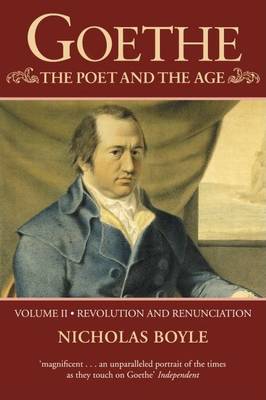
When Volume I of Nicholas Boyle's biography of Goethe appeared, it received an avalanche of praise on both sides of the Atlantic. George Steiner, in The New Yorker, called it "the best biography of Goethe in English." Doris Lessing, in The Independent, called it "biography at its best." And The New York Times Book Review hailed it as "a remarkable achievement," adding "there is nothing comparable to this study in any language."
Now comes the second volume of this definitive portrait, published on the 250th anniversary of Goethe's birth. Here Nicholas Boyle chronicles the most eventful and crowded years of Goethe's life: the period of the French Revolution--which turned Goethe's life upside down--and of the philosophical revolution in Germany which ushered in the periods of Idealism and Romanticism. It was also a period dominated by two intense personal relationships--with Schiller, Weimar's other great poet, philosopher, and dramatist, and with Christiana Vulpius, the mother of his son. Boyle paints vivid portraits of Goethe's harrowing experiences of the Revolutionary wars, of the explosion of new ideas in philosophy and literature which for ten years made Jena the intellectual capital of Europe, and of the upheavals sparked by Napoleon which destroyed the Holy Roman Empire.
Boyle captures both the large-scale events that swept Europe and the personal dramas of this exciting time. And he offers brilliant new analyses of Goethe's works of the period, most notably Wilhelm Meister, The Natural Daughter, and Faust. Indeed, this volume is a major work of historical and literary scholarship, and an important biography of one of the giants of Western culture.
Now comes the second volume of this definitive portrait, published on the 250th anniversary of Goethe's birth. Here Nicholas Boyle chronicles the most eventful and crowded years of Goethe's life: the period of the French Revolution--which turned Goethe's life upside down--and of the philosophical revolution in Germany which ushered in the periods of Idealism and Romanticism. It was also a period dominated by two intense personal relationships--with Schiller, Weimar's other great poet, philosopher, and dramatist, and with Christiana Vulpius, the mother of his son. Boyle paints vivid portraits of Goethe's harrowing experiences of the Revolutionary wars, of the explosion of new ideas in philosophy and literature which for ten years made Jena the intellectual capital of Europe, and of the upheavals sparked by Napoleon which destroyed the Holy Roman Empire.
Boyle captures both the large-scale events that swept Europe and the personal dramas of this exciting time. And he offers brilliant new analyses of Goethe's works of the period, most notably Wilhelm Meister, The Natural Daughter, and Faust. Indeed, this volume is a major work of historical and literary scholarship, and an important biography of one of the giants of Western culture.
Specificaties
Betrokkenen
- Auteur(s):
- Uitgeverij:
Inhoud
- Aantal bladzijden:
- 988
- Taal:
- Engels
Eigenschappen
- Productcode (EAN):
- 9780199257515
- Verschijningsdatum:
- 18/09/2003
- Uitvoering:
- Paperback
- Formaat:
- Trade paperback (VS)
- Afmetingen:
- 154 mm x 238 mm
- Gewicht:
- 1360 g


Alleen bij Standaard Boekhandel
+ 83 punten op je klantenkaart van Standaard Boekhandel
Cadeau

AANGERADEN


Beoordelingen
We publiceren alleen reviews die voldoen aan de voorwaarden voor reviews. Bekijk onze voorwaarden voor reviews.