


- Afhalen na 1 uur in een winkel met voorraad
- Gratis thuislevering in België vanaf € 30
- Ruim aanbod met 7 miljoen producten
- Afhalen na 1 uur in een winkel met voorraad
- Gratis thuislevering in België vanaf € 30
- Ruim aanbod met 7 miljoen producten





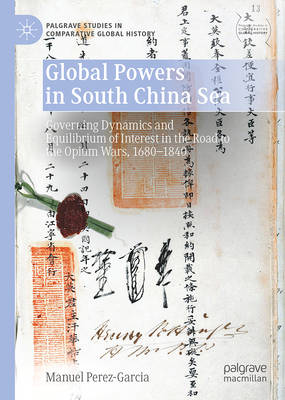
Global Powers in South China Sea
Governing Dynamics and Equilibrium of Interest in the Road to the Opium Wars, 1680-1840
Manuel Perez-Garcia
€ 244,45
+ 488 punten
Omschrijving
This book examines the dynamic interplay of consumer behaviour, trade networks, and long-distance alliances in driving economic growth across Qing China, Western Europe, and the Spanish American colonies from 1680 to 1840. Employing a reciprocal comparative framework, it illuminates the deep structural interconnections between Western and Chinese market systems. By utilising the innovative GECEM Database, which cross-references Western and Chinese primary sources to mine new archival data, the study constitutes a methodological advance that offers fresh insights into the Great Divergence debate.
Moving beyond an analysis of large-scale structures, this work emphasises the decisive agency of traders. By facilitating the bidirectional flow of Chinese goods to the West and European commodities to China, merchants catalysed a transformation: they reconfigured consumption, spawned new demand, and reshaped transcontinental socioeconomic relations.
The study situates these dynamics within critical geopolitical junctures: the establishment of maritime customs under the Kangxi emperor in 1680, the closure of trade and rise of the Canton system under Qianlong in 1756, and the outbreak of the Opium Wars in 1840. These turning points illuminate transformations in trade strategies, local economies, state capacity, and relations between merchants and officials across the Ming-Qing transition.
Engaging with recent scholarship, Global Powers offers a new perspective on Qing economic and political practices, as well as the dynasty's geopolitical tensions, through a local lens on foreign trade networks. It is an essential reading for specialists in global and economic history, sinology, East Asian studies, early modern history, as well as for economists and scholars of Sino-European relations.
Specificaties
Betrokkenen
- Auteur(s):
- Uitgeverij:
Inhoud
- Taal:
- Engels
- Reeks:
Eigenschappen
- Productcode (EAN):
- 9781349961528
- Verschijningsdatum:
- 16/08/2026
- Uitvoering:
- Hardcover
- Formaat:
- Genaaid
- Afmetingen:
- 148 mm x 210 mm


Alleen bij Standaard Boekhandel
+ 488 punten op je klantenkaart van Standaard Boekhandel
Cadeau

AANGERADEN


Beoordelingen
We publiceren alleen reviews die voldoen aan de voorwaarden voor reviews. Bekijk onze voorwaarden voor reviews.