


- Afhalen na 1 uur in een winkel met voorraad
- Gratis thuislevering in België vanaf € 30
- Ruim aanbod met 7 miljoen producten
- Afhalen na 1 uur in een winkel met voorraad
- Gratis thuislevering in België vanaf € 30
- Ruim aanbod met 7 miljoen producten





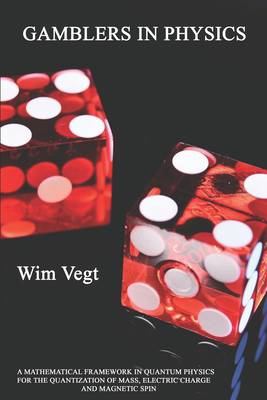
Gamblers in Physics
A Mathematical Framework in Physics for the Quantization of Mass, Electric Charge and Magnetic Spin
Wim Vegt
Paperback | Engels
€ 54,00
+ 108 punten
Omschrijving
According to Maxwell's equations Electromagnetic Waves can only propagate along straight lines and it is impossible that Light (Electromagnetic Waves) could confine with the surface of a sphere or an ellipse. For that reason, these material waves in Schrödinger's wave equation could only be of a different origin than Electromagnetic Waves. Niels Bohr introduced the concept of "Probability Waves" as the origin of the material waves in Schrödinger's wave equation. And defined the New Concept that the electron was still a particle but the physical presence of the electron in the Atom was equally divided by a spherical probability function. In the New Theory it will be demonstrated that because of a mistake in the Maxwell Equations, in 1927 Confined Electromagnetic waves could not be considered to be the material waves expressed in Schrödinger's wave equation. The New Theory presents a new equation describing electromagnetic field configurations which are also solutions of the Schrodinger's wave equation and the relativistic quantum mechanical Dirac Equation and carry mass, electric charge and magnetic spin at discrete values.
Specificaties
Betrokkenen
- Auteur(s):
- Uitgeverij:
Inhoud
- Aantal bladzijden:
- 260
- Taal:
- Engels
Eigenschappen
- Productcode (EAN):
- 9789464182736
- Verschijningsdatum:
- 11/11/2020
- Uitvoering:
- Paperback
- Formaat:
- Trade paperback (VS)
- Afmetingen:
- 152 mm x 229 mm
- Gewicht:
- 485 g


Alleen bij Standaard Boekhandel
+ 108 punten op je klantenkaart van Standaard Boekhandel
AANGERADEN


Beoordelingen
We publiceren alleen reviews die voldoen aan de voorwaarden voor reviews. Bekijk onze voorwaarden voor reviews.