



Je cadeautjes zeker op tijd in huis hebben voor de feestdagen? Kom langs in onze winkels en vind het perfecte geschenk!
- Afhalen na 1 uur in een winkel met voorraad
- Gratis thuislevering in België vanaf € 30
- Ruim aanbod met 7 miljoen producten
Je cadeautjes zeker op tijd in huis hebben voor de feestdagen? Kom langs in onze winkels en vind het perfecte geschenk!
- Afhalen na 1 uur in een winkel met voorraad
- Gratis thuislevering in België vanaf € 30
- Ruim aanbod met 7 miljoen producten





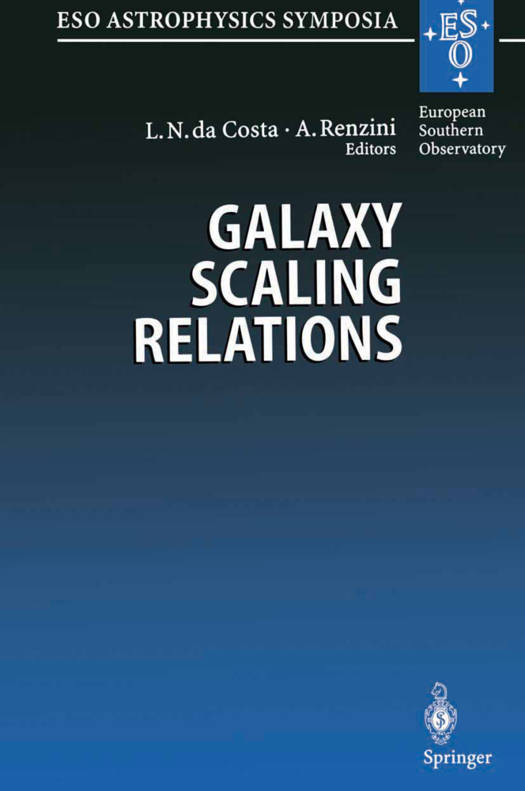
Galaxy Scaling Relations: Origins, Evolution and Applications
Proceedings of the Eso Workshop Held at Garching, Germany, 18-20 November 1996
€ 83,95
+ 167 punten
Omschrijving
At close inspection every galaxy appears to have its own individuality.A galaxy can be warped, lop-sided, doubly-nucleated, boxy or disky, ... in its own specific, peculiar way. Hence, for a complete description, galaxy taxonomy may ask for finer and finer classification schemes. However, for some applications it may be more fruitful to let details aside and focus on some global properties of galaxies. One is then seeking to measure just a few quantities for each galaxy, a minimum set of globalobservables that yet captures some essential aspect of these objects. One very successful example of this approach is offered by the scaling rela- tions of galaxies, the subject of the international workshop held at ESO head- quarters in Garching on November 19-21, 1996. Discovered in the late 1970's, the Tully-Fisher relation for the spirals and the Faber-Jackson relation, or its more recent version the Fundamental Plane, for ellipticals have now become flourishing fields of astronomical research in their own right, as well as being widely used tools for a broad range of astronomical investigations. The work- shop was designed to address three key issues on galaxy scaling relations, i.e., their Origins, Evolution, and Applications in astronomy. The Origins of galaxy scaling relations still escape our full understanding.
Specificaties
Betrokkenen
- Uitgeverij:
Inhoud
- Aantal bladzijden:
- 404
- Taal:
- Engels
- Reeks:
Eigenschappen
- Productcode (EAN):
- 9783662219348
- Verschijningsdatum:
- 18/04/2014
- Uitvoering:
- Paperback
- Formaat:
- Trade paperback (VS)
- Afmetingen:
- 156 mm x 234 mm
- Gewicht:
- 594 g

Alleen bij Standaard Boekhandel
+ 167 punten op je klantenkaart van Standaard Boekhandel
CADEAU


Beoordelingen
We publiceren alleen reviews die voldoen aan de voorwaarden voor reviews. Bekijk onze voorwaarden voor reviews.