


- Afhalen na 1 uur in een winkel met voorraad
- Gratis thuislevering in België vanaf € 30
- Ruim aanbod met 7 miljoen producten
- Afhalen na 1 uur in een winkel met voorraad
- Gratis thuislevering in België vanaf € 30
- Ruim aanbod met 7 miljoen producten





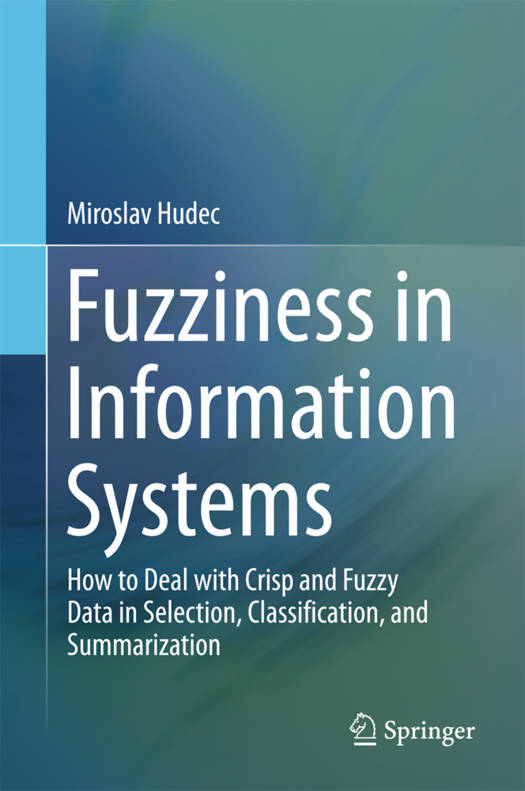
Fuzziness in Information Systems
How to Deal with Crisp and Fuzzy Data in Selection, Classification, and Summarization
Miroslav Hudec
Hardcover | Engels
€ 108,45
+ 216 punten
Uitvoering
Omschrijving
This book is an essential contribution to the description of fuzziness in information systems. Usually users want to retrieve data or summarized information from a database and are interested in classifying it or building rule-based systems on it. But they are often not aware of the nature of this data and/or are unable to determine clear search criteria. The book examines theoretical and practical approaches to fuzziness in information systems based on statistical data related to territorial units.
Chapter 1 discusses the theory of fuzzy sets and fuzzy logic to enable readers to understand the information presented in the book. Chapter 2 is devoted to flexible queries and includes issues like constructing fuzzy sets for query conditions, and aggregation operators for commutative and non-commutative conditions, while Chapter 3 focuses on linguistic summaries. Chapter 4 presents fuzzy logic control architecture adjusted specifically for the aims of business and governmental agencies, and shows fuzzy rules and procedures for solving inference tasks. Chapter 5 covers the fuzzification of classical relational databases with an emphasis on storing fuzzy data in classical relational databases in such a way that existing data and normal forms are not affected. This book also examines practical aspects of user-friendly interfaces for storing, updating, querying and summarizing. Lastly, Chapter 6 briefly discusses possible integration of fuzzy queries, summarization and inference related to crisp and fuzzy databases.
The main target audience of the book is researchers and students working in the fields of data analysis, database design and business intelligence. As it does not go too deeply into the foundation and mathematical theory of fuzzy logic and relational algebra, it is also of interest to advanced professionals developing tailored applications based on fuzzy sets.
Chapter 1 discusses the theory of fuzzy sets and fuzzy logic to enable readers to understand the information presented in the book. Chapter 2 is devoted to flexible queries and includes issues like constructing fuzzy sets for query conditions, and aggregation operators for commutative and non-commutative conditions, while Chapter 3 focuses on linguistic summaries. Chapter 4 presents fuzzy logic control architecture adjusted specifically for the aims of business and governmental agencies, and shows fuzzy rules and procedures for solving inference tasks. Chapter 5 covers the fuzzification of classical relational databases with an emphasis on storing fuzzy data in classical relational databases in such a way that existing data and normal forms are not affected. This book also examines practical aspects of user-friendly interfaces for storing, updating, querying and summarizing. Lastly, Chapter 6 briefly discusses possible integration of fuzzy queries, summarization and inference related to crisp and fuzzy databases.
The main target audience of the book is researchers and students working in the fields of data analysis, database design and business intelligence. As it does not go too deeply into the foundation and mathematical theory of fuzzy logic and relational algebra, it is also of interest to advanced professionals developing tailored applications based on fuzzy sets.
Specificaties
Betrokkenen
- Auteur(s):
- Uitgeverij:
Inhoud
- Aantal bladzijden:
- 198
- Taal:
- Engels
Eigenschappen
- Productcode (EAN):
- 9783319425160
- Verschijningsdatum:
- 7/10/2016
- Uitvoering:
- Hardcover
- Formaat:
- Genaaid
- Afmetingen:
- 156 mm x 234 mm
- Gewicht:
- 489 g



Alleen bij Standaard Boekhandel
+ 216 punten op je klantenkaart van Standaard Boekhandel
CADEAU

AANGERADEN


Beoordelingen
We publiceren alleen reviews die voldoen aan de voorwaarden voor reviews. Bekijk onze voorwaarden voor reviews.