


- Afhalen na 1 uur in een winkel met voorraad
- Gratis thuislevering in België vanaf € 30
- Ruim aanbod met 7 miljoen producten
- Afhalen na 1 uur in een winkel met voorraad
- Gratis thuislevering in België vanaf € 30
- Ruim aanbod met 7 miljoen producten





€ 313,95
+ 627 punten
Omschrijving
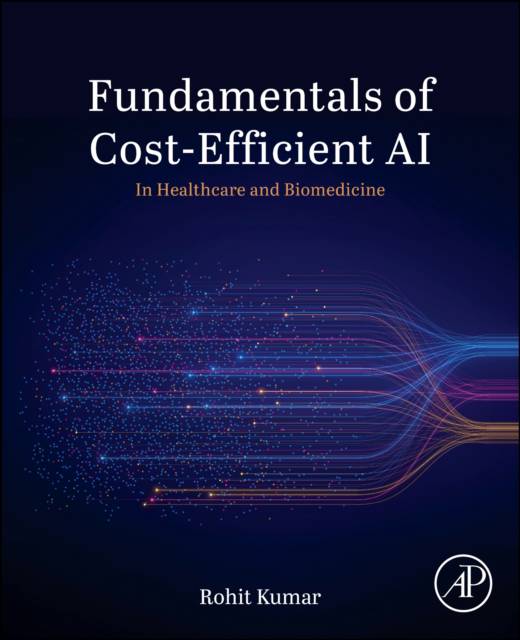
Fundamentals of Cost-Efficient AI: In Healthcare and Biomedicine provides a comprehensive yet accessible introduction to the principles of designing, training, and deploying efficient artificial intelligence systems. It explains the theory behind cost-aware machine learning and data mining and examines methods across deep learning, graph neural networks (GNNs), transformer architectures, diffusion models, reinforcement learning, and knowledge distillation.
The book covers fine-tuning and compression techniques such as low-rank adaptation (LoRA), parameter-efficient fine-tuning (PEFT), adapter-based tuning, pruning, and quantization. It also explores inference acceleration through Flash Attention, prefill optimization, and speculative decoding, and explains how mixture-of-experts (MoE) architectures can scale models efficiently across GPUs and edge devices.
To build a strong conceptual understanding, the text introduces fundamentals of GPU architecture, matrix multiplication, memory hierarchies, and parallelization strategies, helping readers develop an intuition for optimizing training and inference pipelines.
While applicable across domains, the book places special emphasis on healthcare and biomedicine, where efficient AI can reduce costs and improve diagnostics, precision medicine, and clinical decision support. Real-world case studies and interviews with experts from organizations such as Google and Microsoft provide practical insights into building scalable healthcare AI systems. Aimed at graduate students, researchers, clinicians, biomedical engineers, data scientists, and AI practitioners, this book bridges algorithmic principles with applied implementation.
The book covers fine-tuning and compression techniques such as low-rank adaptation (LoRA), parameter-efficient fine-tuning (PEFT), adapter-based tuning, pruning, and quantization. It also explores inference acceleration through Flash Attention, prefill optimization, and speculative decoding, and explains how mixture-of-experts (MoE) architectures can scale models efficiently across GPUs and edge devices.
To build a strong conceptual understanding, the text introduces fundamentals of GPU architecture, matrix multiplication, memory hierarchies, and parallelization strategies, helping readers develop an intuition for optimizing training and inference pipelines.
While applicable across domains, the book places special emphasis on healthcare and biomedicine, where efficient AI can reduce costs and improve diagnostics, precision medicine, and clinical decision support. Real-world case studies and interviews with experts from organizations such as Google and Microsoft provide practical insights into building scalable healthcare AI systems. Aimed at graduate students, researchers, clinicians, biomedical engineers, data scientists, and AI practitioners, this book bridges algorithmic principles with applied implementation.
Specificaties
Betrokkenen
- Auteur(s):
- Uitgeverij:
Inhoud
- Aantal bladzijden:
- 434
- Taal:
- Engels
Eigenschappen
- Productcode (EAN):
- 9780443333620
- Verschijningsdatum:
- 9/12/2025
- Uitvoering:
- Paperback
- Formaat:
- Trade paperback (VS)
- Afmetingen:
- 190 mm x 236 mm
- Gewicht:
- 929 g


Alleen bij Standaard Boekhandel
+ 627 punten op je klantenkaart van Standaard Boekhandel
Cadeau

AANGERADEN


Beoordelingen
We publiceren alleen reviews die voldoen aan de voorwaarden voor reviews. Bekijk onze voorwaarden voor reviews.