


- Afhalen na 1 uur in een winkel met voorraad
- Gratis thuislevering in België vanaf € 30
- Ruim aanbod met 7 miljoen producten
- Afhalen na 1 uur in een winkel met voorraad
- Gratis thuislevering in België vanaf € 30
- Ruim aanbod met 7 miljoen producten





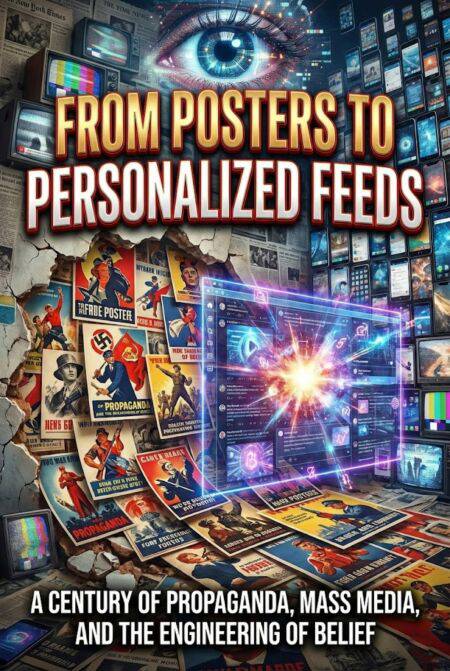
From Posters to Personalized Feeds E-BOOK
A Century of Propaganda, Mass Media, and the Engineering of Belief
Sarah Whitfield
E-book | Engels
€ 8,99
+ 8 punten
Omschrijving
The tools have changed beyond recognition. The intent has not. From Posters to Personalized Feeds traces the unbroken line connecting the lithographed war posters of 1914 to the algorithmically curated content streams of the twenty-first century—revealing how each new medium inherited, refined, and amplified the persuasion techniques of its predecessor.
This book examines propaganda not as an aberration of authoritarian regimes but as a structural feature of modern mass communication. It follows the evolution of influence across six transformative moments: the print mobilization of the First World War, the radio empires of the interwar period, the cinematic machinery of fascist and Soviet states, the television age of the Cold War, the cable news fragmentation of the 1990s, and the micro-targeted digital ecosystems of today. At each stage, the same core mechanisms reappear—emotional priming, in-group identity, enemy construction, and the suppression of ambiguity.
Drawing on archival propaganda materials, declassified government communication strategies, and media scholarship, this is an authoritative and accessible history of how mass belief is made—and what it costs when the engineering goes unexamined.
This book examines propaganda not as an aberration of authoritarian regimes but as a structural feature of modern mass communication. It follows the evolution of influence across six transformative moments: the print mobilization of the First World War, the radio empires of the interwar period, the cinematic machinery of fascist and Soviet states, the television age of the Cold War, the cable news fragmentation of the 1990s, and the micro-targeted digital ecosystems of today. At each stage, the same core mechanisms reappear—emotional priming, in-group identity, enemy construction, and the suppression of ambiguity.
Drawing on archival propaganda materials, declassified government communication strategies, and media scholarship, this is an authoritative and accessible history of how mass belief is made—and what it costs when the engineering goes unexamined.
Specificaties
Betrokkenen
- Auteur(s):
- Uitgeverij:
Inhoud
- Aantal bladzijden:
- 187
- Taal:
- Engels
Eigenschappen
- Productcode (EAN):
- 9783565274635
- Verschijningsdatum:
- 25/02/2026
- Uitvoering:
- E-book
- Formaat:
- ePub


Alleen bij Standaard Boekhandel
+ 8 punten op je klantenkaart van Standaard Boekhandel
AANGERADEN


Beoordelingen
We publiceren alleen reviews die voldoen aan de voorwaarden voor reviews. Bekijk onze voorwaarden voor reviews.