


- Afhalen na 1 uur in een winkel met voorraad
- Gratis thuislevering in België vanaf € 30
- Ruim aanbod met 7 miljoen producten
- Afhalen na 1 uur in een winkel met voorraad
- Gratis thuislevering in België vanaf € 30
- Ruim aanbod met 7 miljoen producten





€ 77,45
+ 154 punten
Omschrijving
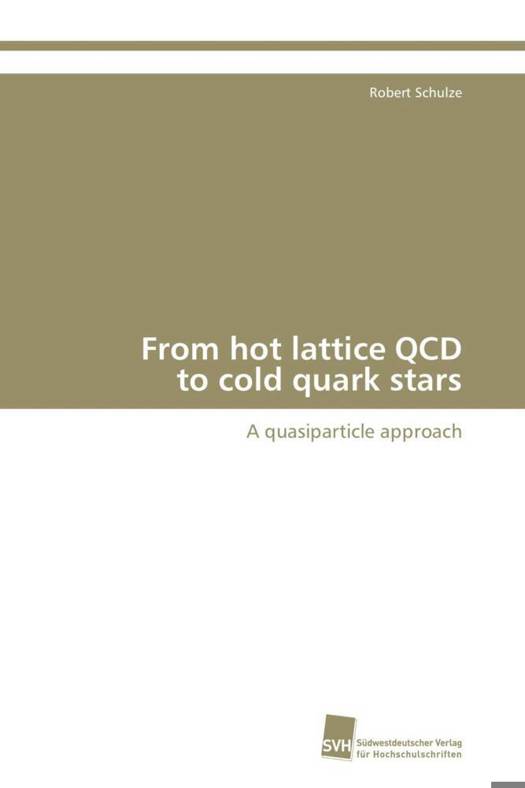
The work connects the fields of Elementary Particle-, Collider- and Astrophysics. A thermodynamic model of the quark-gluon plasma using quasiparticle degrees of freedom based on the hard thermal loop self-energies is introduced. It provides a link between an established quasiparticle model - following from the former using a series of approximations - and QCD - from which the former is derived using the Cornwall-Jackiw-Tomboulis formalism and a special parametrization of the running coupling. Both models allow for an extrapolation of first-principle QCD results available at small chemical potentials using Monte-Carlo methods to large net baryon densities with remarkably similar results. They are used to construct equations of state for heavy-ion collider experiments at SPS and FAIR as well as quark and neutron star interiors. A mixed-phase construction allows for a connection of the SPS equation of state to the hadron resonance gas including an extension to the weak sector. From the extrapolation of the most recent lattice results the existence of bound pure quark stars is not suggested. However, quark matter might exist in a hybrid phase in cores of neutron stars.
Specificaties
Betrokkenen
- Auteur(s):
- Uitgeverij:
Inhoud
- Aantal bladzijden:
- 156
- Taal:
- Engels
Eigenschappen
- Productcode (EAN):
- 9783838131283
- Verschijningsdatum:
- 9/02/2012
- Uitvoering:
- Paperback
- Afmetingen:
- 152 mm x 220 mm
- Gewicht:
- 236 g


Alleen bij Standaard Boekhandel
+ 154 punten op je klantenkaart van Standaard Boekhandel
CADEAU


Beoordelingen
We publiceren alleen reviews die voldoen aan de voorwaarden voor reviews. Bekijk onze voorwaarden voor reviews.