


- Afhalen na 1 uur in een winkel met voorraad
- Gratis thuislevering in België vanaf € 30
- Ruim aanbod met 7 miljoen producten
- Afhalen na 1 uur in een winkel met voorraad
- Gratis thuislevering in België vanaf € 30
- Ruim aanbod met 7 miljoen producten




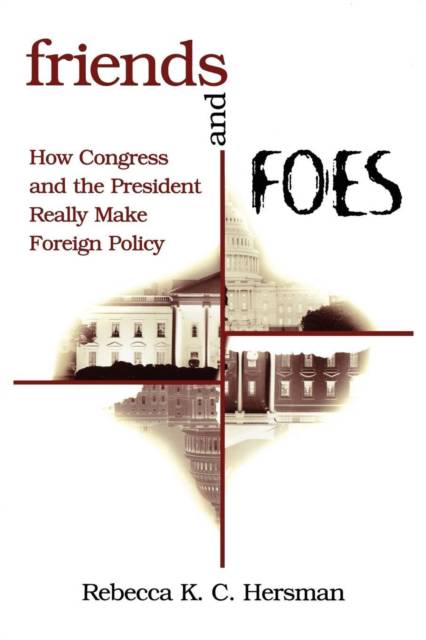
Friends and Foes
How Congress and the President Really Make Foreign Policy
Rebecca K C Hersman
Paperback | Engels
€ 44,45
+ 88 punten
Omschrijving
Foreign policy in the post-cold war era is profoundly complex, and so too are the institutions that share the responsibility to guide and manage America's relations with other countries. Policymakers struggle within porous and fragmented institutions, in which policy is driven more powerfully by clusters of like-minded individuals than by disciplined organizations. The nation's political parties face deep divisions over foreign policy and are unable to forge a coherent vision for the future. Congress is increasingly polarized along ideological lines, while traditional internationalist foreign policy spans a truncated political center. Few aspects of U.S. politics are more contentious or controversial than the respective roles of Congress and the executive branch in formulating foreign policy. In this complex environment, scholars, pundits, and policymakers look to the public and high-profile battles between Congress and the president as a bellwether of the future of U.S. foreign policy.In reality, foreign policy is often shaped, debated, and made out of public view. In Friends and Foes, Rebecca K. C. Hersman shifts the focus away from headline-grabbing events and disagreements to the day-to-day interactions that form the backbone of policymaking.Hersman illustrates the ebb and flow of foreign policy development through many examples and anecdotes. She also includes three in-depth case studies from the mid-1990s: the controversial transfer of three U.S. warships to Turkey; the dispute over relaxing sanctions against Pakistan because of concerns about that nation's nuclear proliferation record, and the 1995-97 battle over the Chemical Weapons Convention. The book also illuminates the role of the media in influencing the outcome of foreign policy decisionmaking. Countering the conventional wisdom that a president and a Congress of the same political party are best able to ""get things done,"" Friends and Foes sheds new light on the institutional dynamics, conflicts, and issue loyalties that affect the development of U.S. foreign policy.
Specificaties
Betrokkenen
- Auteur(s):
- Uitgeverij:
Inhoud
- Aantal bladzijden:
- 154
- Taal:
- Engels
Eigenschappen
- Productcode (EAN):
- 9780815735656
- Verschijningsdatum:
- 1/06/2000
- Uitvoering:
- Paperback
- Formaat:
- Trade paperback (VS)
- Afmetingen:
- 152 mm x 229 mm
- Gewicht:
- 235 g


Alleen bij Standaard Boekhandel
+ 88 punten op je klantenkaart van Standaard Boekhandel
AANGERADEN


Beoordelingen
We publiceren alleen reviews die voldoen aan de voorwaarden voor reviews. Bekijk onze voorwaarden voor reviews.