


- Afhalen na 1 uur in een winkel met voorraad
- Gratis thuislevering in België vanaf € 30
- Ruim aanbod met 7 miljoen producten
- Afhalen na 1 uur in een winkel met voorraad
- Gratis thuislevering in België vanaf € 30
- Ruim aanbod met 7 miljoen producten





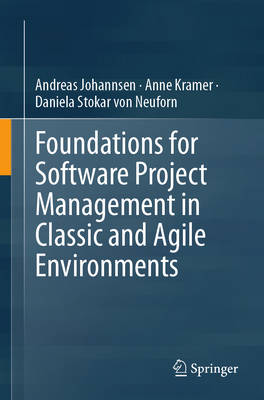
Foundations for Software Project Management in Classic and Agile Environments
Andreas Johannsen, Anne Kramer, Daniela Stokar Von Neuforn
Paperback | Engels
€ 54,45
+ 108 punten
Omschrijving
This book provides the necessary foundational knowledge in the increasingly critical field of software project management. It follows the curriculum of the ASQF(R) Certified Professional for Project Management (CPPM) certification scheme. It is, however, suitable for any introductory academic or professional course in the field. Different project management frameworks exist. Some of them still cultivate the idea of an omnipotent project manager, while others call themselves "agile" and distribute the burden of the task among several shoulders. Yet without a common language, communication is difficult. Consequently, the book starts with definitions of important terms and an overview of project management practices based on the ISO 21502:2020(E) standard. This helps projects establish consistent terminology and a common understanding of the activities. These activities are explained in detail, starting with project initiation, project planning, implementation, and controlling, to project acceptance and closing. Separate chapters are devoted to the overarching processes of quality assurance, risk management, human resource management, and maturity models. A continuous case study, anecdotes from the authors' past projects, and numerous illustrations turn the otherwise dry topic into a practical, enjoyable read. Projects are social systems, and when they fail, it is often due to human-related reasons. Motivation, leadership, and soft skills in general are as important as knowing effort estimation methods or change management processes. The book therefore conveys knowledge on two levels: the technical level with its methods and practices, and the human level with its roles and skills. This book is not only for those who have been appointed as project managers or who are considering it as a career path in sequential environments, but also for everyone working in agile software projects. Numerous practical exercises with sample solutions help both practitioners and university students deepen their understanding of this fascinating field.
Specificaties
Betrokkenen
- Auteur(s):
- Uitgeverij:
Inhoud
- Aantal bladzijden:
- 333
- Taal:
- Engels
Eigenschappen
- Productcode (EAN):
- 9783032167965
- Verschijningsdatum:
- 14/06/2026
- Uitvoering:
- Paperback
- Formaat:
- Trade paperback (VS)
- Afmetingen:
- 155 mm x 235 mm


Alleen bij Standaard Boekhandel
+ 108 punten op je klantenkaart van Standaard Boekhandel
Cadeau

AANGERADEN


Beoordelingen
We publiceren alleen reviews die voldoen aan de voorwaarden voor reviews. Bekijk onze voorwaarden voor reviews.