


- Afhalen na 1 uur in een winkel met voorraad
- Gratis thuislevering in België vanaf € 30
- Ruim aanbod met 7 miljoen producten
- Afhalen na 1 uur in een winkel met voorraad
- Gratis thuislevering in België vanaf € 30
- Ruim aanbod met 7 miljoen producten





€ 39,38
+ 39 punten
Omschrijving
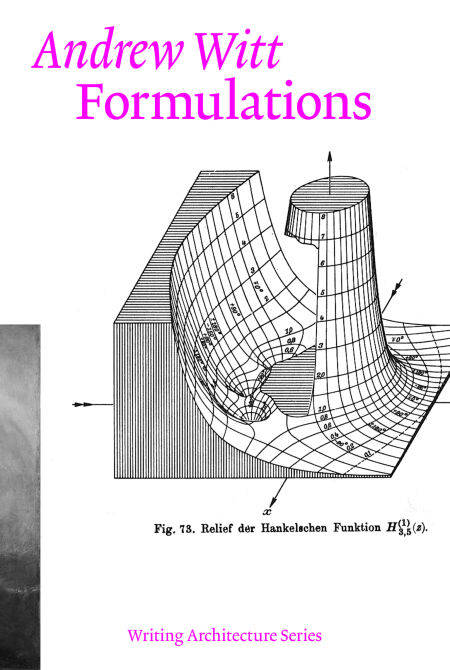
An investigation of mathematics as it was drawn, encoded, imagined, and interpreted by architects on the eve of digitization in the mid-twentieth century.
In Formulations, Andrew Witt examines the visual, methodological, and cultural intersections between architecture and mathematics. The linkages Witt explores involve not the mystic transcendence of numbers invoked throughout architectural history, but rather architecture’s encounters with a range of calculational systems—techniques that architects inventively retooled for design. Witt offers a catalog of mid-twentieth-century practices of mathematical drawing and calculation in design that preceded and anticipated digitization as well as an account of the formal compendia that became a cultural currency shared between modern mathematicians and modern architects.
Witt presents a series of extensively illustrated “biographies of method”—episodes that chart the myriad ways in which mathematics, particularly the mathematical notion of modeling and drawing, was spliced into the creative practice of design. These include early drawing machines that mechanized curvature; the incorporation of geometric maquettes—“theorems made flesh”—into the toolbox of design; the virtualization of buildings and landscapes through surveyed triangulation and photogrammetry; formal and functional topology; stereoscopic drawing; the economic implications of cubic matrices; and a strange synthesis of the technological, mineral, and biological: crystallographic design.
Trained in both architecture and mathematics, Witt uses mathematics as a lens through which to understand the relationship between architecture and a much broader set of sciences and visual techniques. Through an intercultural exchange with other disciplines, he argues, architecture adapted not only the shapes and surfaces of mathematics but also its values and epistemic ideals.
In Formulations, Andrew Witt examines the visual, methodological, and cultural intersections between architecture and mathematics. The linkages Witt explores involve not the mystic transcendence of numbers invoked throughout architectural history, but rather architecture’s encounters with a range of calculational systems—techniques that architects inventively retooled for design. Witt offers a catalog of mid-twentieth-century practices of mathematical drawing and calculation in design that preceded and anticipated digitization as well as an account of the formal compendia that became a cultural currency shared between modern mathematicians and modern architects.
Witt presents a series of extensively illustrated “biographies of method”—episodes that chart the myriad ways in which mathematics, particularly the mathematical notion of modeling and drawing, was spliced into the creative practice of design. These include early drawing machines that mechanized curvature; the incorporation of geometric maquettes—“theorems made flesh”—into the toolbox of design; the virtualization of buildings and landscapes through surveyed triangulation and photogrammetry; formal and functional topology; stereoscopic drawing; the economic implications of cubic matrices; and a strange synthesis of the technological, mineral, and biological: crystallographic design.
Trained in both architecture and mathematics, Witt uses mathematics as a lens through which to understand the relationship between architecture and a much broader set of sciences and visual techniques. Through an intercultural exchange with other disciplines, he argues, architecture adapted not only the shapes and surfaces of mathematics but also its values and epistemic ideals.
Specificaties
Betrokkenen
- Auteur(s):
- Uitgeverij:
Inhoud
- Aantal bladzijden:
- 432
- Taal:
- Engels
- Reeks:
Eigenschappen
- Productcode (EAN):
- 9780262366854
- Verschijningsdatum:
- 10/01/2022
- Uitvoering:
- E-book
- Beveiligd met:
- Adobe DRM
- Formaat:
- ePub


Alleen bij Standaard Boekhandel
+ 39 punten op je klantenkaart van Standaard Boekhandel
Cadeau

AANGERADEN


Beoordelingen
We publiceren alleen reviews die voldoen aan de voorwaarden voor reviews. Bekijk onze voorwaarden voor reviews.