


- Afhalen na 1 uur in een winkel met voorraad
- Gratis thuislevering in België vanaf € 30
- Ruim aanbod met 7 miljoen producten
- Afhalen na 1 uur in een winkel met voorraad
- Gratis thuislevering in België vanaf € 30
- Ruim aanbod met 7 miljoen producten





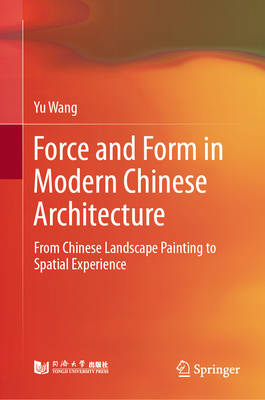
Force and Form in Modern Chinese Architecture
From Chinese Landscape Painting to Spatial Experience
Yu Wang
Hardcover | Engels
€ 213,95
+ 427 punten
Omschrijving
This book systematically explores how the Daoist principle of "Tao follows its own nature" is transformed into perceptible spatial forms in contemporary architecture through the aesthetics of Chinese landscape painting. It offers an in-depth analysis of traditional techniques such as the Three Distances, Cun, and scattered perspective, revealing how visual imagery is converted into spatial experience. Through the perspective of phenomenology and cross-cultural aesthetics, the book establishes a structural connection between art and architecture. Focusing on core cases of Wang Shu's Xiangshan Campus and Ningbo Museum, as well as I. M. Pei's Suzhou Museum and Miho Museum, the book illustrates how oriental aesthetic is shown through architectural circulation, material texture, and the play of light and shadow. Meanwhile, this book emphasizes on the importance of Chinese landscape painting in the context of globalization in the new century, revealing how it can achieve locality and universality simultaneously. In specific, bilingual interpretation and illustration is used, concept explanation and visual charts are shown in both Chinese and English to help cross-cultural readers understand Eastern architectural aesthetics. Using sketches, photographs, and narrative accounts, it invites readers to "walk" between landscape painting and architectural space. Through the interdisciplinary integration of art history, architectural theory, phenomenology, and ecological philosophy, the book offers architects, landscape designers, urban planners, and scholars of art history and visual culture a fresh research framework.


Alleen bij Standaard Boekhandel
+ 427 punten op je klantenkaart van Standaard Boekhandel
Cadeau

AANGERADEN


Beoordelingen
We publiceren alleen reviews die voldoen aan de voorwaarden voor reviews. Bekijk onze voorwaarden voor reviews.