


- Afhalen na 1 uur in een winkel met voorraad
- Gratis thuislevering in België vanaf € 30
- Ruim aanbod met 7 miljoen producten
- Afhalen na 1 uur in een winkel met voorraad
- Gratis thuislevering in België vanaf € 30
- Ruim aanbod met 7 miljoen producten





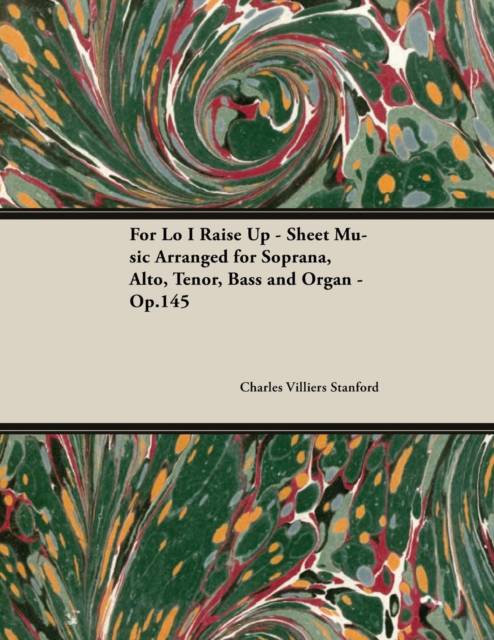
For Lo I Raise Up - Sheet Music Arranged for Soprana, Alto, Tenor, Bass and Organ - Op.145
Charles Villiers Stanford
Paperback | Engels
€ 23,45
+ 46 punten
Omschrijving
This volume contains the original music notation for "For Lo I Raise Up, Op.145", a 1914 classical music composition for the voice and organ by Charles V. Stanford. Although composed in 1914, it was not published until 1939. Disgusted by the war and what Germany had done to its artistic heritage, Stanford endeavoured to express his hope for Britain's different future using the analogy of Habakkuk's Old Testament prophecies. This piece is set to the words of "For Lo, I Raise Up" and is not to be missed by those with an interest in Christian music or the seminal works of Stanford. Sir Charles Villiers Stanford (1852 - 1924) was an Irish composer, conductor, and teacher of music. He was educated at the University of Cambridge and continued his studies in Berlin and Leipzig. He was a very influential composer, responsible for making Cambridge University Musical Society an internationally-acclaimed organisation. Stanford was also a profuse composer, producing a large corpus of work in many genres; however, he is perhaps best remembered for his Anglican choral works for church performance. Many vintage books such as this are becoming increasingly scarce and expensive. We are republishing this volume now in a modern, high-quality edition complete with a specially commissioned new introduction on the history of the organ.
Specificaties
Betrokkenen
- Auteur(s):
- Uitgeverij:
Inhoud
- Aantal bladzijden:
- 18
- Taal:
- Engels
Eigenschappen
- Productcode (EAN):
- 9781528706964
- Verschijningsdatum:
- 14/12/2018
- Uitvoering:
- Paperback
- Formaat:
- Trade paperback (VS)
- Afmetingen:
- 216 mm x 279 mm
- Gewicht:
- 68 g


Alleen bij Standaard Boekhandel
+ 46 punten op je klantenkaart van Standaard Boekhandel
Cadeau

AANGERADEN


Beoordelingen
We publiceren alleen reviews die voldoen aan de voorwaarden voor reviews. Bekijk onze voorwaarden voor reviews.