


- Afhalen na 1 uur in een winkel met voorraad
- Gratis thuislevering in België vanaf € 30
- Ruim aanbod met 7 miljoen producten
- Afhalen na 1 uur in een winkel met voorraad
- Gratis thuislevering in België vanaf € 30
- Ruim aanbod met 7 miljoen producten





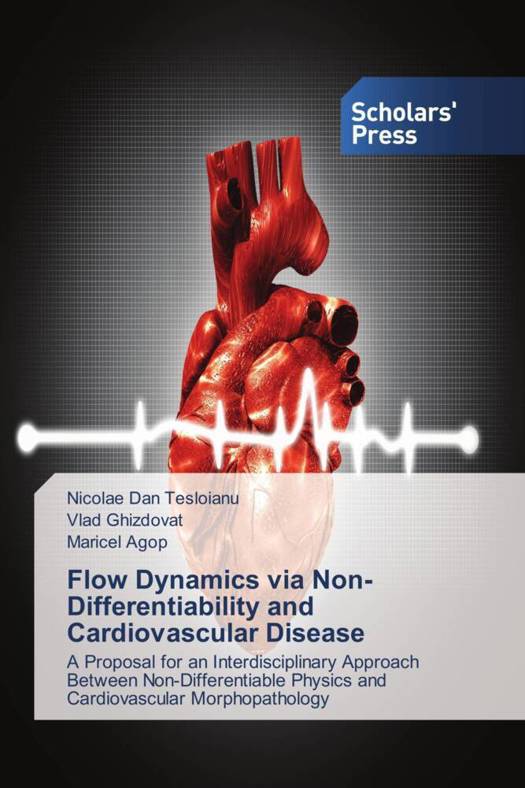
Flow Dynamics via Non-Differentiability and Cardiovascular Disease
A Proposal for an Interdisciplinary Approach Between Non-Differentiable Physics and Cardiovascular Morphopathology
Nicolae Dan Tesloianu, Vlad Ghizdovat, Maricel Agop
Paperback | Engels
€ 35,45
+ 70 punten
Omschrijving
Flow dynamics regimen via non-differentiability in complex fluids and its implication in cardiovascular pathology represent a beginning for an interdisciplinary approach, that would satisfy both physicists and physicians, towards a better understanding of arteriosclerosis. Since the non-differentiability appears as a universal property of the complex systems, non-differentiable physics should be applied in the theoretical modelling of the interactions that take place between the components of the cardiovascular system. Considering that the entities of the complex system are moving on continuous but non-differentiable curves, we show that the "control" of different behaviours of these systems implies fractal physics. The use of this physics allows us to redefine the terms of "good" and "bad" cholesterol, to propose both a fractal theory for explanation of unstable atheroma plaque and a holographic model for endothelial healing, to define a possible "zero moment" of arteriosclerosis initiation as well as a mechanism for acute occlusion of a healthy artery and to suggest an explanation for complex phenomena generating cardiac arrhythmias, mainly by analysing the routes to chaos.
Specificaties
Betrokkenen
- Auteur(s):
- Uitgeverij:
Inhoud
- Aantal bladzijden:
- 96
- Taal:
- Engels
Eigenschappen
- Productcode (EAN):
- 9783639667950
- Verschijningsdatum:
- 2/04/2015
- Uitvoering:
- Paperback
- Afmetingen:
- 150 mm x 220 mm
- Gewicht:
- 150 g


Alleen bij Standaard Boekhandel
+ 70 punten op je klantenkaart van Standaard Boekhandel
Cadeau

AANGERADEN


Beoordelingen
We publiceren alleen reviews die voldoen aan de voorwaarden voor reviews. Bekijk onze voorwaarden voor reviews.